GS 2: International RelationsGS 3: EconomyPrelimsGS 3: Indian Economy, Planning, Mobilization of Resources, Growth, Development and EmploymentGS 3: Infrastructure: Energy, Ports, Roads, Airports, Railways etc.
Reducing India’s Exposure to U.S. Tariff Risks, Pg6
US tariffs up to 110% on India for Russian oil imports threaten $47 billion welfare loss; export diversification and EU FTA critical.
Practice MCQs
804 Students attempted
Key Highlights:
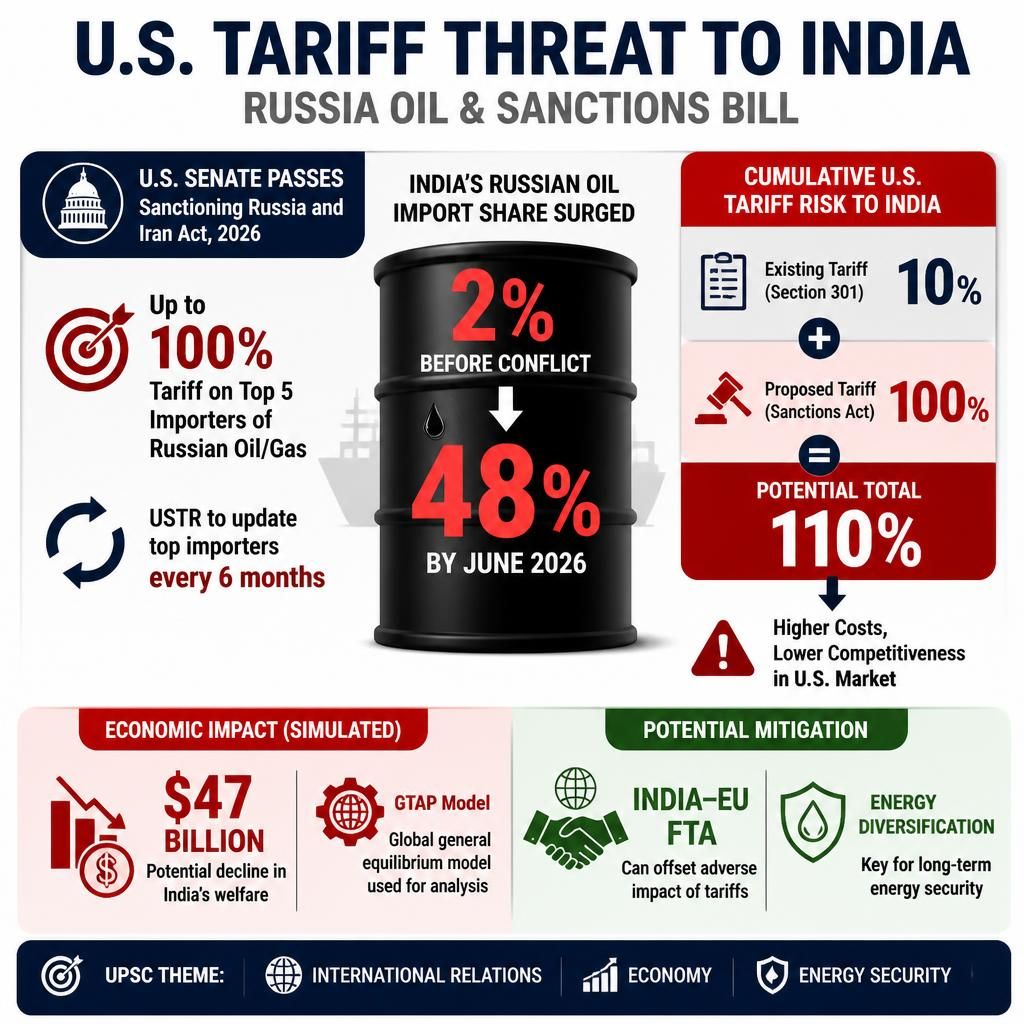
- The U.S. Senate passed the Lindsey O. Graham Sanctioning Russia and Iran Act of 2026, which could impose tariffs of up to 100% on major importers of Russian oil, including India.
- India already faces an additional 10% tariff under Section 301 of the Trade Act of 1974 due to U.S. forced-labor tariffs imposed in July 2026.
- If the new Act becomes law, India's cumulative U.S. tariff could reach 110%, significantly impacting its price competitiveness in the U.S. market.
- India's imports of Russian crude oil have surged from 2% before the Russia-Ukraine conflict to nearly 50% by June 2026, driven by energy diversification and discounted prices.
- Trade simulations suggest a potential $47 billion decline in India's welfare under sanctions, but an India-European Union Free Trade Agreement (FTA) could mitigate these adverse effects.
US Tariff Threat.jpg
Detailed Insights:
- The Lindsey O. Graham Sanctioning Russia and Iran Act of 2026 passed the U.S. Senate on August 7, 2026, and now awaits approval from the House of Representatives.
- This proposed legislation authorizes tariffs of up to 100% on the top five importers of Russian crude oil or natural gas, and countries facilitating sanctions evasion.
- The U.S. Trade Representative (USTR) is mandated to recalculate the top five importers every six months to update enforcement eligibility.
- The existing 10% tariff on India was imposed under Section 301 of the Trade Act of 1974, which allows the USTR to act against foreign unfair trade practices.
- India's increased reliance on Russian oil, reaching 48% of its total crude imports by June 2026, is a strategic move for energy security but creates diplomatic challenges with the U.S.
- The GTAP dataset and model, a global general equilibrium model, was utilized for trade simulations, demonstrating the economic impact of potential tariffs.
- A functional India-European Union Free Trade Agreement (FTA), concluded on January 27, 2026, is projected to improve India's welfare by $26.3 billion and boost exports.
- Beyond trade agreements, India needs sustained domestic reforms, including trade facilitation, removal of non-tariff barriers, and improved logistics, to enhance export competitiveness.
Key Concepts Involved:
- Sanctions: Economic penalties imposed by one country on another to influence policy or behavior.
- Tariffs: Taxes levied on imported goods, increasing their cost and potentially reducing their competitiveness.
- Section 301 of the Trade Act of 1974: U.S. trade law authorizing the USTR to investigate and respond to foreign unfair trade practices.
- Free Trade Agreement (FTA): A pact between two or more countries to reduce barriers to imports and exports among them.
- GTAP Model: A global general equilibrium model used for analyzing the economic impacts of trade and other policies.
- Export Diversification: A strategy to expand export markets and product ranges to reduce reliance on a few key destinations or goods.

SuperKalam is your personal mentor for UPSC preparation, guiding you at every step of the exam journey.
Download the App


STUDY RESOURCES
CONTACT US
ⓒ Snapstack Technologies Private Limited