GS 2: GovernanceGS 2: PolityGS 1: Indian SocietyGS 2: Social JusticePrelims
Why are govt. schools shutting down?, Pg8
NITI Aayog report reveals 94,000 government schools closed over a decade, impacting 2.26 crore children, disproportionately affecting vulnerable communities.
Practice MCQs
797 Students attempted
Key Highlights:
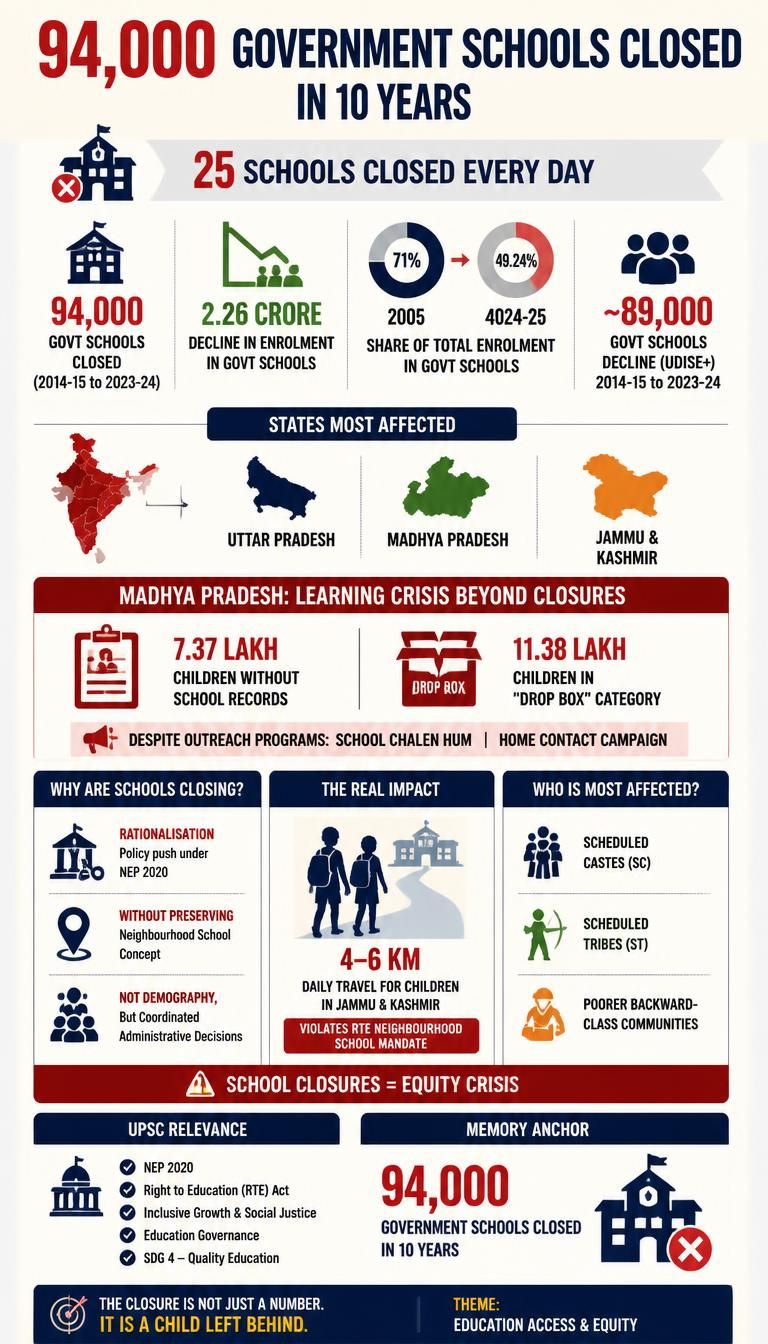
- A NITI Aayog report indicates that approximately 94,000 government schools have closed over the past decade, averaging 25 closures daily.
- This has led to a 2.26 crore decline in government school enrollment, with their share of total enrollment falling from 71% in 2005 to 49.24% in 2024-25.
- States like Uttar Pradesh, Madhya Pradesh, and Jammu and Kashmir are most affected by these closures.
- UDISE+ figures confirm a national decline of about 89,000 government schools between 2014-15 and 2023-24.
- Madhya Pradesh reported 7.37 lakh children without school records and 11.38 lakh in the "Drop Box" category, despite outreach programs like School Chalen Hum and the Home Contact Campaign.
Government Schools.jpg
Detailed Insights:
- School closures are primarily attributed to "rationalisation," a policy advocated by the National Education Policy 2020, but often without preserving the concept of neighbourhood schools.
- These closures are not merely due to demographic shifts but are coordinated administrative decisions, disproportionately affecting the poorest and most rural children.
- In Jammu and Kashmir, school rationalisation has forced children to travel 4 to 6 km daily, violating the neighbourhood school mandates of the Right to Education Act (RTE).
- Government schools predominantly serve children from Scheduled Castes, Scheduled Tribes, and poorer backward-class communities, making closures a significant equity issue.
- The burden of school closures falls disproportionately on girls, who are often the first to be withdrawn from education when access becomes difficult.
- The RTE Act, while guaranteeing free and compulsory education, is criticized for not being effectively justiciable, especially for poor and rural parents.
- The Centre attributes responsibility for school closures to states, as education is on the Concurrent List, yet it intervenes through funding conditionalities and language policies.
Key Concepts Involved:
- Rationalisation: The process of optimizing resources, in this context, by merging or closing schools with low enrollment or proximity to other schools.
- National Education Policy 2020 (NEP 2020): A comprehensive framework for education in India, aiming to transform the education system from early childhood to higher education.
- Right to Education Act (RTE): A landmark act passed in 2009, making education a fundamental right for children aged 6 to 14 years in India.
- Concurrent List: A list of 52 items in the Seventh Schedule of the Indian Constitution, on which both the Union and State governments can legislate.

SuperKalam is your personal mentor for UPSC preparation, guiding you at every step of the exam journey.
Download the App


STUDY RESOURCES
CONTACT US
ⓒ Snapstack Technologies Private Limited