GS 2: GovernanceGS 1: Indian SocietyGS 3: EconomyPrelimsGS 3: Inclusive Growth
Between growth haves, have-nots, mind the lag, Pg10
India's economic growth creates a widening gap between surging billionaire wealth and stagnant average wages, impacting consumption and demanding urgent job creation.
Practice MCQs
797 Students attempted
Key Highlights:
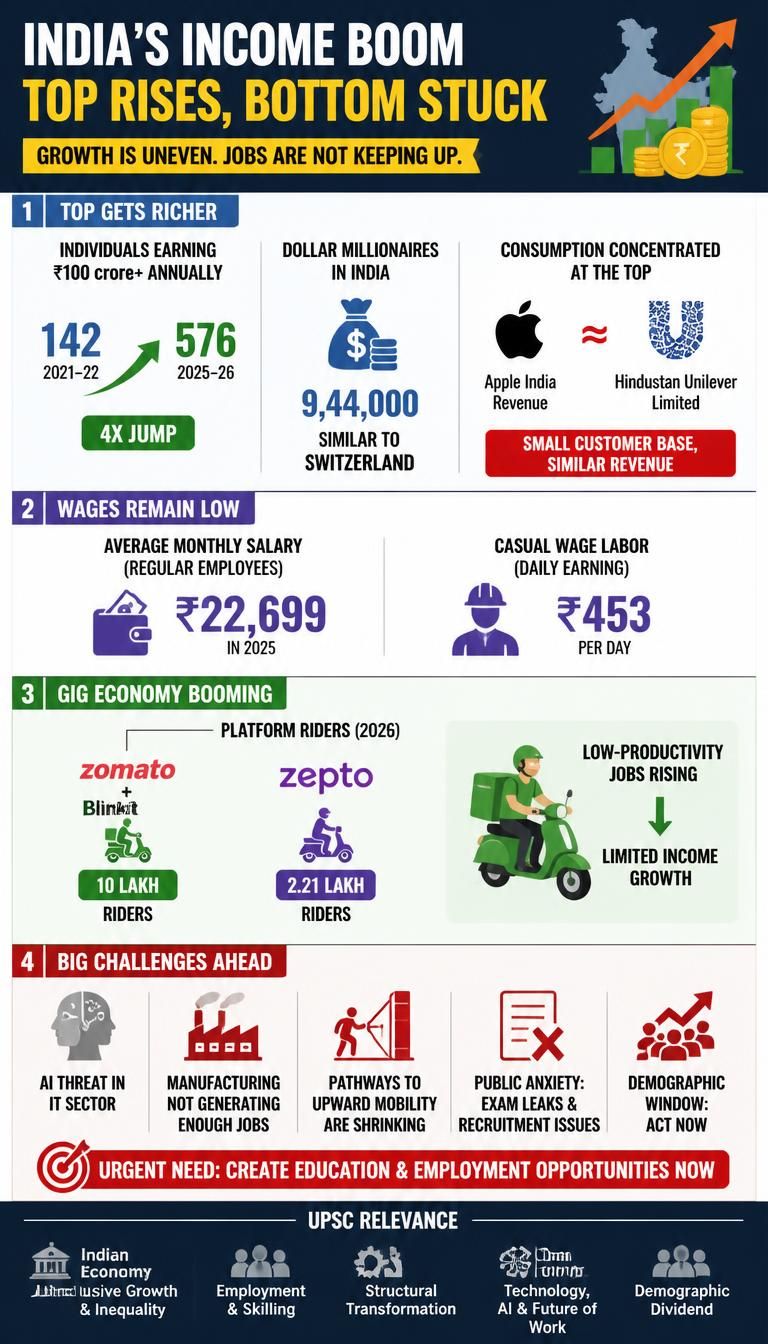
- The number of individuals earning over Rs 100 crore annually increased from 142 in 2021-22 to 576 in 2025-26, as per the Lok Sabha.
- India has 9,44,000 dollar millionaires, placing it similarly to Switzerland, according to the UBS Global Wealth Report 2026.
- The average monthly salary for regular employees was Rs 22,699 in 2025, while casual wage labor earned Rs 453 daily.
- Consumption growth is concentrated at the top, with Apple India's revenue nearing Hindustan Unilever Limited despite a smaller customer base.
- The gig economy is expanding rapidly, with Zomato and Blinkit platforms having 10 lakh riders, and Zepto reaching 2.21 lakh riders in 2026.
Income Inequality.jpg
Detailed Insights:
- The data highlights a significant increase in income and wealth for a small segment of the Indian population.
- This rapid income expansion at the top contrasts with sluggish employment and wage growth for the majority, leading to an uneven consumption base.
- Pathways for upward mobility are perceived to be shrinking, partly due to the AI threat in the IT sector.
- Unlike other developing economies, India's manufacturing sector is not generating sufficient employment to absorb the growing labor force.
- The rise of low-productivity jobs, such as delivery riders, indicates a shift in the nature of available employment opportunities.
- Public anxieties regarding access to quality education and jobs are reflected in protests over exam leaks and recruitment processes.
- India is currently experiencing a demographic window, making the urgent creation of education and employment opportunities crucial.
- The Periodic Labour Force Survey provides essential data on employment and wage trends, informing policy decisions.
Key Concepts Involved:
- Income Inequality: The unequal distribution of income among a population, where a small percentage holds a disproportionately large share.
- Gig Economy: A labor market characterized by short-term contracts or freelance work, often facilitated by digital platforms.
- Demographic Dividend: The economic growth potential that can result from shifts in a population’s age structure, particularly when the share of the working-age population is larger than the non-working-age share.
- Periodic Labour Force Survey (PLFS): A large-scale household survey conducted by the National Sample Survey Office (NSSO) to estimate key employment and unemployment indicators in India.

SuperKalam is your personal mentor for UPSC preparation, guiding you at every step of the exam journey.
Download the App


STUDY RESOURCES
CONTACT US
ⓒ Snapstack Technologies Private Limited