GS 3: Science & TechnologyGS 3: Environment & EcologyPrelimsGS 3: Conservation, Pollution and DegradationGS 1: Changes in Critical Geographical Features, Water Bodies, Ice Caps, Flora and Fauna
A lepidoptera hotspot, India is home to 8.25% of the world’s butterflies, moths, Pg12
Zoological Survey of India scientists publish monumental catalogue of 13,703 lepidoptera species, positioning India as a megadiverse nation with 8.25% of global diversity.
Practice MCQs
797 Students attempted
Key Highlights:
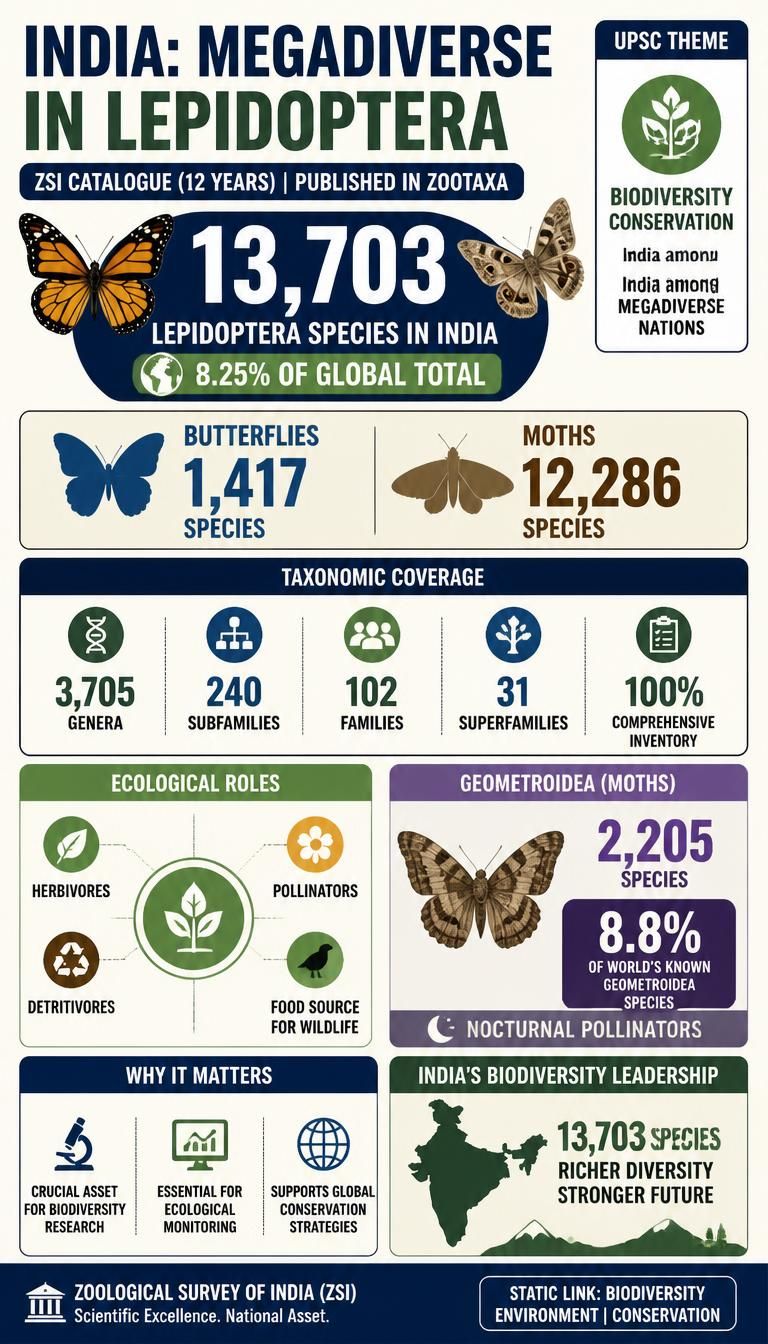
- India is home to 13,703 species of Lepidoptera (butterflies and moths), constituting approximately 8.25% of the global total.
- The Zoological Survey of India (ZSI) published a detailed "Catalogue of Lepidoptera (Butterflies & Moths) of India" in the peer-reviewed journal Zootaxa.
- This comprehensive catalogue, which took 12 years to complete, firmly positions India among megadiverse nations with an updated inventory of its butterfly and moth diversity.
- Of the total Lepidoptera species, 1,417 are butterflies and 12,286 are moths.
Lepidoptera.jpg
Detailed Insights:
- The catalogue classifies the 13,703 species across 3,705 genera, 240 subfamilies, 102 families, and 31 superfamilies.
- The scientific work by ZSI scientists Navneet Singh and Rahul Joshi addresses critical taxonomic gaps that have persisted for over a century.
- Lepidoptera play vital ecological roles as herbivores, detritivores, and pollinators, and serve as food sources for various animals.
- The catalogue is considered a crucial national asset for biodiversity research, ecological monitoring, and global conservation strategies.
- Among the catalogued species are 2,205 species of Geometroidea, which are nocturnal pollinators.
- These 2,205 Geometroidea species represent 8.8% of the world’s known species in this superfamily.
Key Concepts Involved:
- Lepidoptera: An order of insects that includes butterflies and moths, characterized by scaly wings.
- Zoological Survey of India (ZSI): India's premier organization for zoological research and exploration, operating under the Ministry of Environment, Forest and Climate Change.
- Zootaxa: A peer-reviewed international journal specializing in systematic zoology, particularly for large taxonomic works and descriptions of new taxa.
- Megadiverse nations: Countries that harbor a high percentage of Earth's species, including a significant number of endemic species, and often possess marine ecosystems.

SuperKalam is your personal mentor for UPSC preparation, guiding you at every step of the exam journey.
Download the App


STUDY RESOURCES
CONTACT US
ⓒ Snapstack Technologies Private Limited