GS 2: GovernanceGS 3: Science & TechnologyGS 2: International RelationsGS 3: EconomyPrelims
An Energy Revolution In The Making, Pg7
India's solar revolution, with 21 lakh homes achieving zero electricity bills, drives 6007% capacity growth and $220 billion investment towards Viksit Bharat.
Practice MCQs
811 Students attempted
Key Highlights:
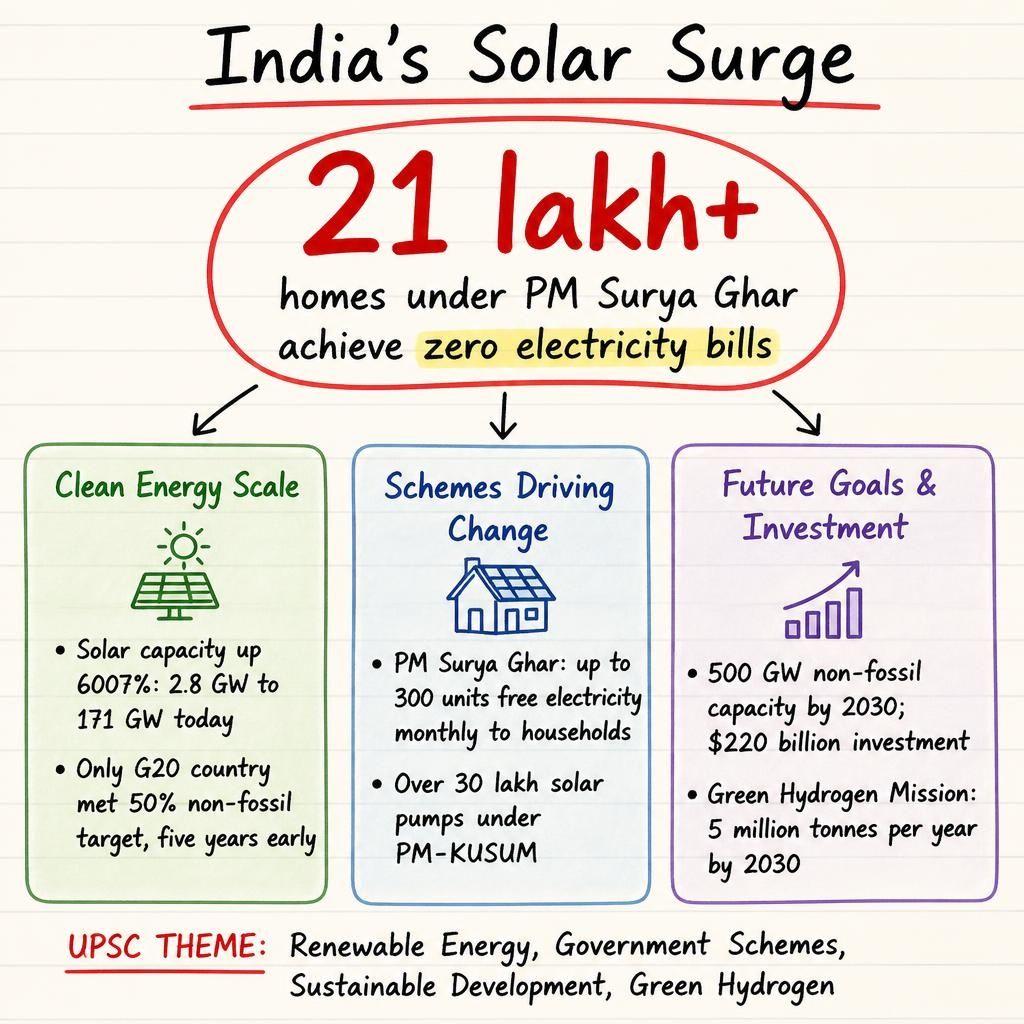
- Over 21 lakh of 65 lakh homes under PM Surya Ghar rooftop solar scheme have achieved zero electricity bills.
- India's installed solar capacity has increased by approximately 6007%, from 2.8 GW in 2014 to 171 GW today.
- The cost of solar power has significantly reduced from ₹8 per unit in 2014-15 to as low as ₹2.15 per unit.
- India is the only G20 country to have met its 2030 target of 50% non-fossil fuel capacity five years early.
- The country aims for 500 GW of installed power capacity from non-fossil fuel sources by 2030, requiring $220 billion in investment.
- Over 30 lakh standalone solar pumps have been installed under the PM-KUSUM scheme, transforming farmers into energy producers.
- The National Green Hydrogen Mission targets 5 million tonnes per year of green hydrogen production by 2030.
Solar Surge.jpg
Detailed Insights:
- The PM Surya Ghar: Muft Bijli Yojana, launched in February 2024, aims to provide up to 300 units of free electricity monthly to one crore households through rooftop solar installations.
- The scheme involves a government investment of over ₹75,000 crore and offers subsidies and concessional bank loans to beneficiaries.
- The second phase of India's energy revolution will focus on agri-photovoltaics under PM-KUSUM 2.0, pairing storage with solar, prioritising state-level green corridors, and deepening rooftop solar penetration.
- India's 500 GW non-fossil fuel commitment by 2030 requires $150 billion domestic and $70 billion Foreign Direct Investment (FDI).
- The Production Linked Incentive (PLI) scheme has boosted domestic manufacturing, with solar module capacity exceeding 225 GW and cell capacity around 45 GW.
- The Central Electricity Authority projects a need for 236 GWh of batteries by 2031-32.
- The recently approved Green Energy Corridor Phase-III will support 50 GWh of Battery Energy Storage Systems (BESS) with ₹50,000 crore and new transmission infrastructure.
- India's 2023 G20 Presidency saw the African Union join the G20, with leaders agreeing to triple renewables capacity by 2030.
- As BRICS Chair, India facilitated the adoption of the New Delhi Declaration, backing a BRICS Solar PV Cooperation Roadmap and principles for smart grids and storage.
- The International Solar Alliance (ISA), co-founded by India and France in 2015, has 130 signatory and member countries and aims to mobilise $1000 billion in investments by 2030.
- The upcoming Bharat Renewable Energy Summit & Expo 2026 will host the Ninth ISA Assembly and Fourth International Conference on Green Hydrogen.
Key Concepts Involved:
- PM Surya Ghar: Muft Bijli Yojana: A government scheme launched in 2024 to provide free electricity to one crore households through rooftop solar installations.
- PM-KUSUM Scheme: A scheme launched in 2019 to provide financial support to farmers for installing standalone solar pumps and grid-connected solar power plants.
- Viksit Bharat by 2047: India's vision to become a developed nation by the 100th year of its independence.
- National Green Hydrogen Mission: An initiative to establish India as a global hub for green hydrogen production, utilization, and export.
- International Solar Alliance (ISA): An intergovernmental organization of 130+ countries working to promote solar energy deployment globally.
- Green Energy Corridor: A program to build dedicated transmission infrastructure for evacuating renewable energy from generation-rich areas to load centers.

SuperKalam is your personal mentor for UPSC preparation, guiding you at every step of the exam journey.
Download the App


STUDY RESOURCES
CONTACT US
ⓒ Snapstack Technologies Private Limited