EthicsGS 3: Science & TechnologyPrelimsGS 4: Ethics and Human InterfaceGS 3: Biotechnology
What Human Brain Tissue Transplanted Into Mice Showed Us, PgII
Stanford researchers successfully transplant human brain organoids into genetically modified mice, creating a 'xenocortical' model to study human brain development and neurological disorders.
Practice MCQs
804 Students attempted
Key Highlights:
- A study published in Nature by neuroscientist Sergiu Pașca’s group at Stanford University successfully transplanted human brain tissue into genetically modified mice.
- The human tissue, grown from induced pluripotent stem cells, was placed into mice whose cerebral cortex and hippocampus were genetically prevented from forming.
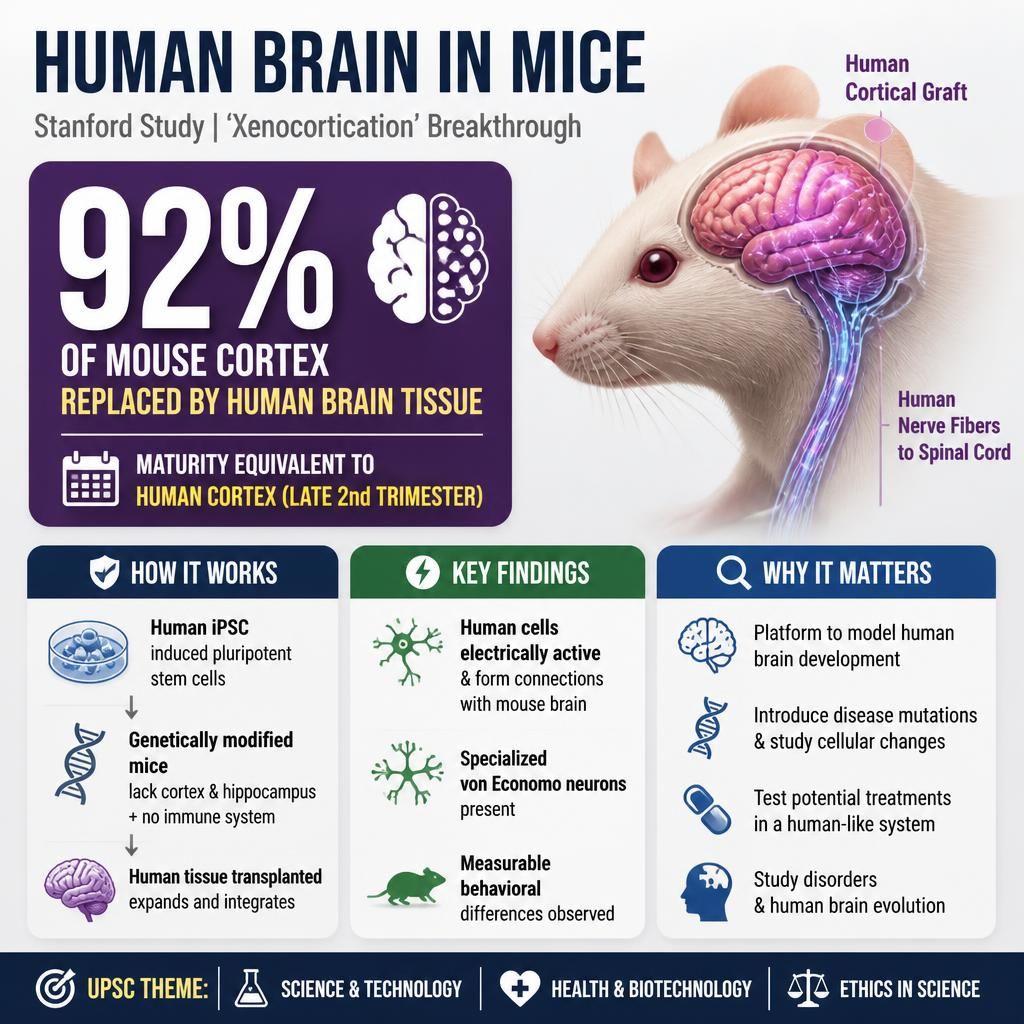
- This novel approach, termed xenocortication, allowed the human grafts to expand significantly, comprising about 92% of the animal’s cortical tissue.
- The transplanted human brain cells became electrically active, formed connections with the mouse nervous system, and included specialized von Economo neurons.
- The experiment demonstrated measurable behavioral differences in the mice and offers a new platform for studying human brain development and neurological disorders.
Human Brain in Mice.jpg
Detailed Insights:
- The mice were specifically bred to lack a functioning immune system, preventing the rejection of the transplanted human tissue.
- The human grafts reached a stage of maturity roughly equivalent to the human cortex late in the second trimester of pregnancy.
- Functional integration was observed, with human nerve fibers extending as far as the cervical spinal cord, a significant finding.
- The platform enables researchers to introduce disease-related mutations, observe cellular changes, assess behavioral impacts, and test potential treatments.
- This model can aid in studying developmental brain disorders, oxygen deprivation injuries, human-specific neuronal diseases, and evolutionary differences in brains.
- Ethical considerations regarding potential alterations to animal cognition and perception were raised, necessitating careful scrutiny for future, more advanced experiments.
Scientific/Technical Concepts Involved:
- Induced pluripotent stem cells: Adult cells reprogrammed to an embryonic-like state, capable of differentiating into various cell types.
- Organoids: Miniaturized, simplified versions of organs produced in vitro from stem cells, mimicking some features of the real organ.
- Xenocortication: An experimental approach involving transplanting human cortical organoids into genetically modified host animals lacking their own cortex.
- Cerebral cortex: The outer layer of the cerebrum, playing a key role in memory, attention, perception, cognition, awareness, thought, language, and consciousness.
- Von Economo neurons: Large, spindle-shaped neurons found in specific regions of the brains of humans and some other large-brained mammals, associated with social cognition.

SuperKalam is your personal mentor for UPSC preparation, guiding you at every step of the exam journey.
Download the App


STUDY RESOURCES
CONTACT US
ⓒ Snapstack Technologies Private Limited