GS 2: GovernanceGS 2: PolityGS 2: Social JusticePrelimsGS 2: Government policies and interventions for development in various sectors
Pregnancy, maternity leave cannot be grounds for demotion at work, says HC, Pg6
Delhi High Court rules against demotion post-maternity leave, citing constitutional equality and dignity, directing companies to ensure equivalent roles and support.
Practice MCQs
797 Students attempted
Key Highlights:
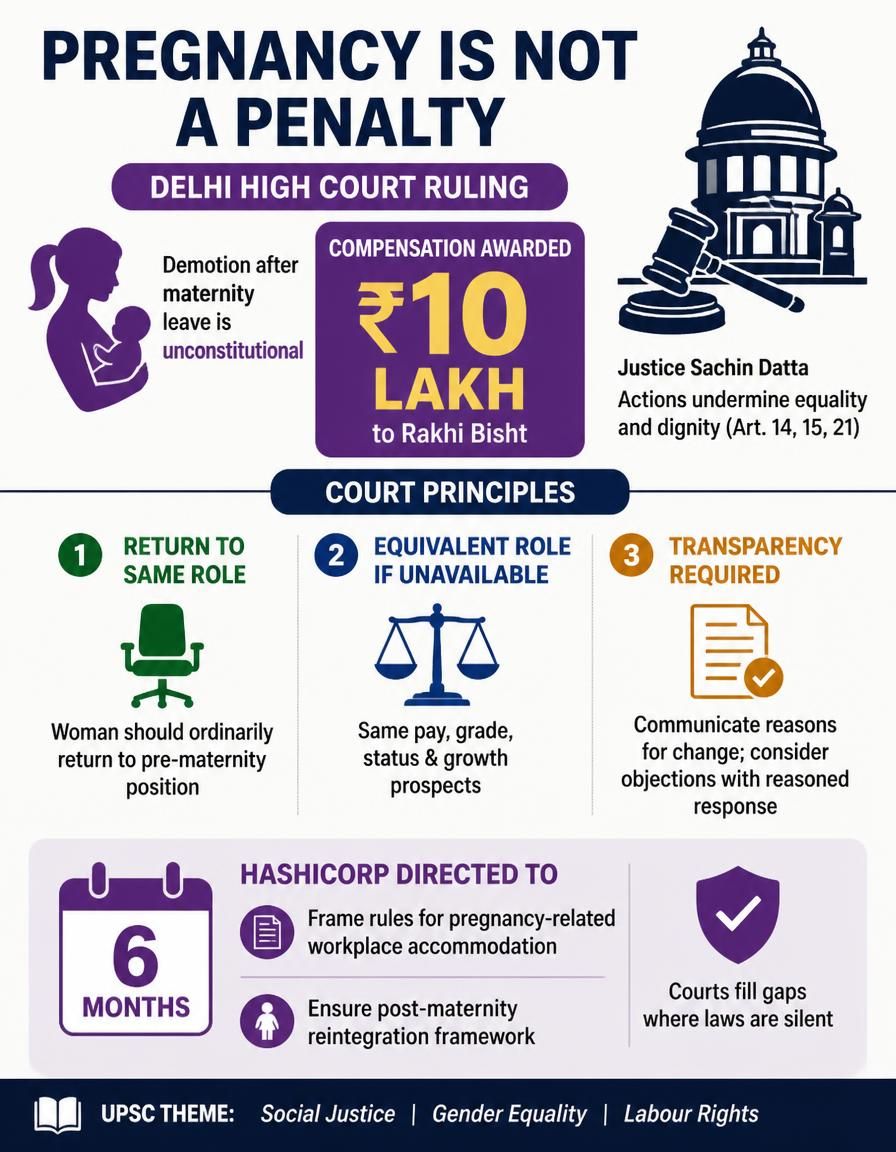
- The Delhi High Court ruled that pregnancy and maternity leave cannot be grounds for demotion or professional disadvantage at work.
- The court awarded Rs 10 lakh in compensation to Rakhi Bisht, who was demoted after returning from maternity leave at HashiCorp.
- Justice Sachin Datta emphasized that such actions undermine constitutional commitments to equality and dignity.
- HashiCorp was directed to frame rules for pregnancy-related workplace accommodation and post-maternity reintegration within six months.
HC on Women.jpg
Detailed Insights:
- Rakhi Bisht, a chartered accountant, found her role reassigned to a lower-level position after returning from maternity leave in July 2024.
- The court stated that a woman should ordinarily return to the position held before maternity leave.
- If the original post is genuinely unavailable, an equivalent role in terms of pay, grade, status, and growth prospects must be provided.
- Employers must communicate reasons for any role change and consider the woman’s objections with a reasoned response.
- The court noted the absence of a comprehensive framework for post-maternity reintegration in the Maternity Benefit Act, 1961, and the Code on Social Security, 2020.
- Suggestions included a "protected period" for women employees from pregnancy disclosure until six months after returning to work.
- Employers would be mandated to conduct individualized assessments for reasonable workplace accommodations within seven days of pregnancy disclosure.
Key Concepts Involved:
- Maternity Benefit Act, 1961: Legislation providing for maternity benefits and leave for women employees in certain establishments.
- Code on Social Security, 2020: A comprehensive law consolidating provisions related to social security, including maternity benefits.
- Article 14: Guarantees equality before the law and equal protection of the laws within the territory of India.
- Article 15: Prohibits discrimination on grounds of religion, race, caste, sex, or place of birth.
- Article 21: Protects the right to life and personal liberty, interpreted to include the right to live with dignity.
- Article 42: Directs the State to make provisions for securing just and humane conditions of work and for maternity relief.

SuperKalam is your personal mentor for UPSC preparation, guiding you at every step of the exam journey.
Download the App


STUDY RESOURCES
CONTACT US
ⓒ Snapstack Technologies Private Limited