GS 2: GovernanceGS 3: Science & TechnologyGS 3: Environment & EcologyPrelimsGS 3: Infrastructure: Energy, Ports, Roads, Airports, Railways etc.
India’s data centre boom is colliding with its climate reality, Pg11
India's rapid data centre expansion collides with climate reality, exacerbating water scarcity, power grid strain, and urban heat, demanding urgent policy reforms.
Practice MCQs
797 Students attempted
Key Highlights:
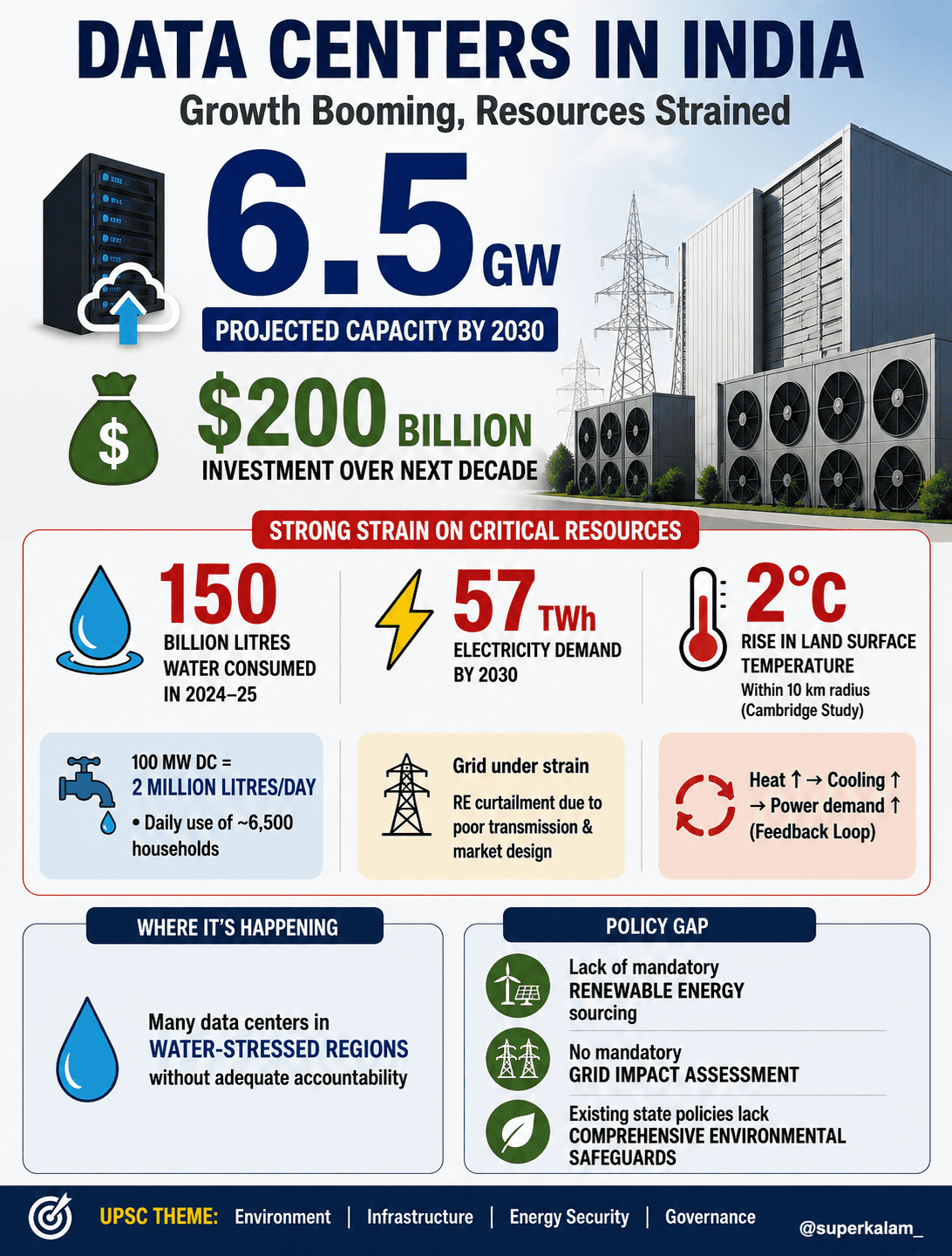
- India's data center capacity is projected to reach 6.5 GW by 2030, attracting nearly $200 billion in investment over the next decade.
- This rapid expansion is straining critical resources, with data centers consuming an estimated 150 billion litres of water in 2024-25.
- States like Maharashtra, Telangana, and Rajasthan are actively promoting data center development, often in water-stressed regions.
- A University of Cambridge study found that data centers raise land surface temperatures by an average of 2°C within a 10 km radius.
- Existing state policies often lack comprehensive environmental safeguards, such as mandatory renewable energy sourcing or grid impact assessments.
Data Center.jpg
Detailed Insights:
- The projected fourfold expansion of data center capacity by 2030 will significantly increase electricity demand to 57 TWh.
- A 100 MW data center consumes about 2 million litres of water daily, equivalent to the daily use of roughly 6,500 households.
- Many data centers are clustering in India’s most water-stressed regions, including Rajasthan and Telangana, without adequate water consumption accountability.
- India's power grid is already under strain, leading to significant renewable energy curtailment due to inadequate transmission infrastructure.
- The Union Ministry of Power indicates that capacity is not the constraint, but rather market design and transmission infrastructure.
- The heat generated by data centers creates a feedback loop, increasing ambient temperatures, which in turn raises cooling demand and electricity consumption.
- State policies offer generous incentives like tax exemptions but often lack conditions for grid impact assessment or mandatory renewable energy sourcing.
- Telangana's policy classifies data centers as "essential services," guaranteeing uninterrupted power even during shortages.
- Maharashtra's policy reduced its renewable energy requirement for data centers from 100% to 51% to improve project viability.
- Gujarat’s new Data Centre Policy 2026-29 mandates at least 51% green energy sourcing, standing out among state policies.
- Experts from Institute for Energy Economics and Financial Analysis (IEEFA) and Council on Energy, Environment and Water advocate for phased power and water use standards.
- Coastal locations offer potential advantages for data centers due to proximity to renewable energy sources and access to seawater for cooling.
Key Concepts Involved:
- Urban Heat Island: A metropolitan area that is significantly warmer than its surrounding rural areas due to human activities and infrastructure.
- Groundwater Stress: A condition where the rate of groundwater extraction exceeds the rate of natural recharge, leading to declining water tables.
- Renewable Energy Curtailment: The reduction of output from renewable energy generators, often due to grid congestion or lack of demand.
- Grid Interconnection: The process of connecting a power generation facility or a large consumer to the national or regional electricity grid.
- Demand Response: Changes in electricity use by end-use customers from their normal consumption patterns in response to changes in electricity prices or grid conditions.

SuperKalam is your personal mentor for UPSC preparation, guiding you at every step of the exam journey.
Download the App


STUDY RESOURCES
CONTACT US
ⓒ Snapstack Technologies Private Limited