GS 2: GovernanceGS 3: Science & TechnologyGS 2: International RelationsGS 3: EconomyPrelims
China, US are in race to connect science with industry. India must catch up, Pg13
India lags significantly in R&D and innovation, risking subaltern status as US and China race to integrate science with industry for global dominance.
Practice MCQs
797 Students attempted
Key Highlights:
- China aims to become the world's leading science power, driven by President Xi Jinping's call to mobilize "new quality productive forces" focused on innovation.
- The United States is also reorienting its science policy, as outlined in "A Science: A New Golden Age," to reintegrate innovation with manufacturing.
- Both nations view Artificial Intelligence (AI) as central to accelerating discovery, transforming industry, and gaining geopolitical advantage.
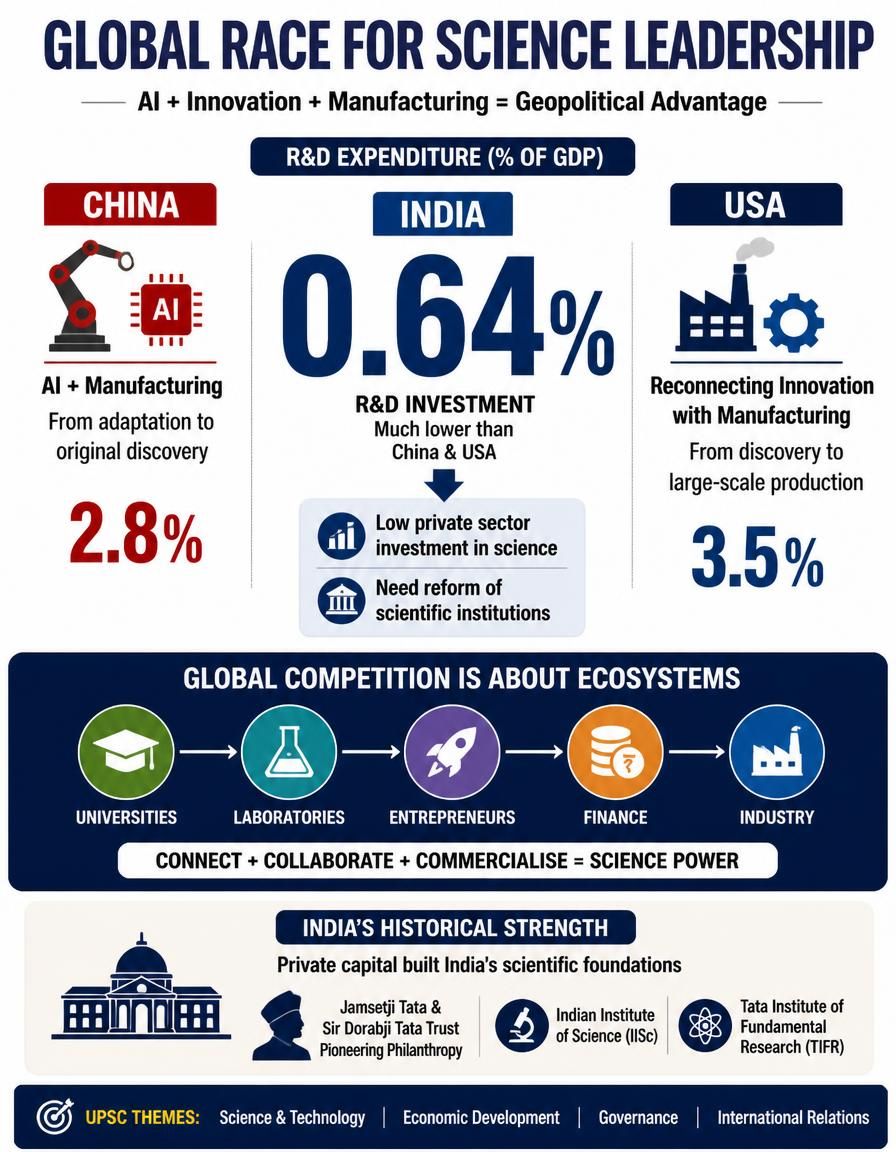
- India's R&D expenditure stands at 0.64% of GDP, significantly lower than China's 2.8% and the US's 3.5%.
- India faces challenges in private sector investment in science and the reform of its scientific institutions.
Science Leadership Race.jpg
Detailed Insights:
- China's strategy involves diffusing AI across its physical economy, leveraging its large manufacturing base to move from technology adaptation to original discovery.
- The US seeks to overcome its weakness in converting discoveries into production, aiming to reconnect its strong innovation ecosystem with manufacturing capabilities.
- The global competition is centered on building effective ecosystems that connect universities, laboratories, entrepreneurs, finance, and industry.
- Historically, Indian private capital, exemplified by Jamsetji Tata and the Sir Dorabji Tata Trust, played a significant role in establishing key scientific institutions like the Indian Institute of Science and the Tata Institute of Fundamental Research.
- India's reform era, unlike China's, did not include a comparable overhaul of its scientific institutions, leading to bureaucratization.
- India needs to deepen global scientific cooperation while simultaneously building domestic research, industrial, and institutional capacity.
Key Concepts Involved:
- New Quality Productive Forces: A Chinese economic concept emphasizing innovation, advanced technology, and high-quality development over traditional growth drivers.
- Technological Sovereignty: A nation's ability to develop, control, and use its own technology, reducing dependence on foreign entities.
- Scientific Temper: A rational and objective way of thinking, characterized by inquiry, evidence-based reasoning, and a rejection of dogma, as promoted in India's constitution.

SuperKalam is your personal mentor for UPSC preparation, guiding you at every step of the exam journey.
Download the App


STUDY RESOURCES
CONTACT US
ⓒ Snapstack Technologies Private Limited