GS 2: International RelationsPrelims
Spain installs floating barrier in Ceuta after deadly migrant rush, Pg 12
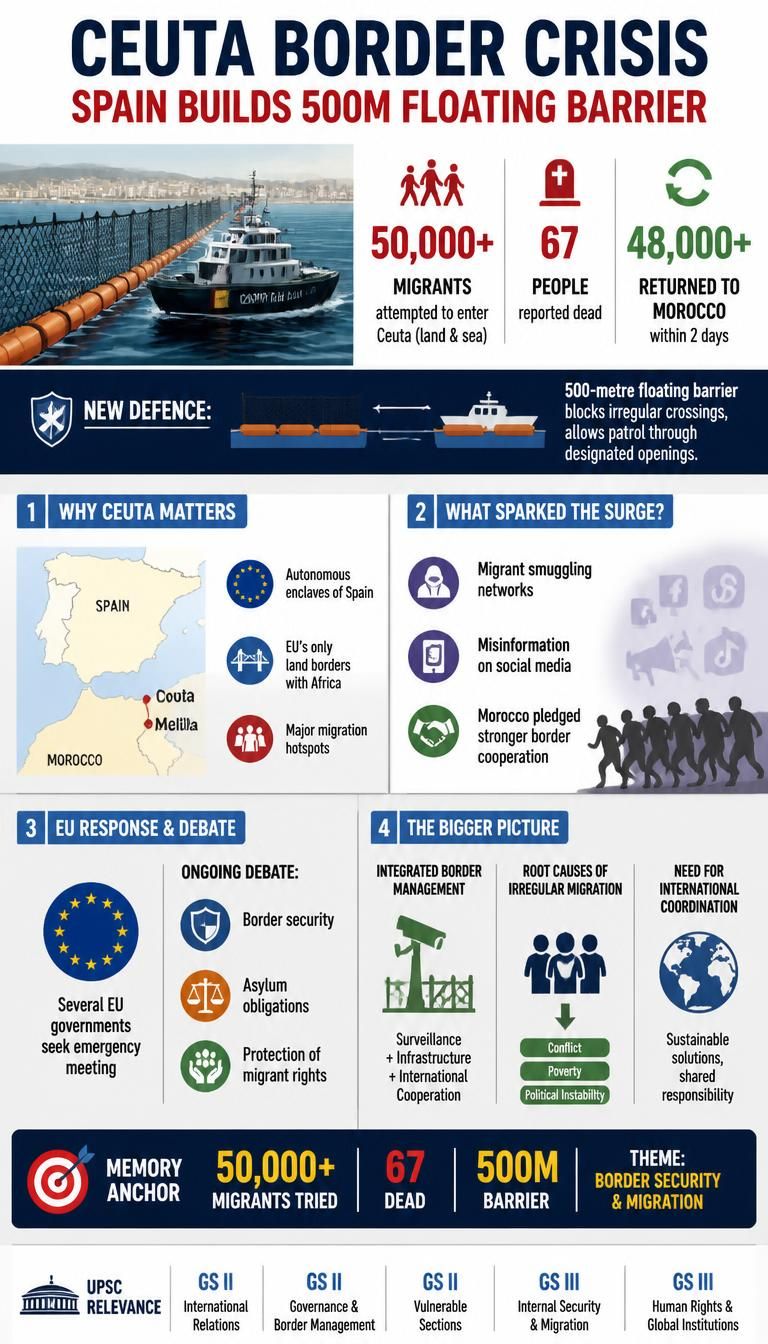
Spain has installed a 500-metre floating barrier along the coast of Ceuta after a massive migrant influx from Morocco left at least 67 people dead.
Practice MCQs
790 Students attempted
Key Highlights:
- Spain has installed a 500-metre floating barrier along the coast of Ceuta after a massive migrant influx from Morocco left at least 67 people dead.
- Around 50,000 migrants attempted to enter Ceuta by land and sea, with over 48,000 reportedly returning to Morocco within two days.
- The barrier is designed to prevent irregular sea crossings while allowing Spanish Civil Guard vessels to operate through designated openings.
- The incident has prompted several European Union (EU) governments to seek an emergency meeting on border security and migration management.
Ceuta.jpg
Detailed Insights:
- Ceuta and Melilla are Spain's autonomous enclaves in North Africa and constitute the European Union's only land borders with Africa, making them major migration hotspots.
- Spanish authorities attributed the surge partly to migrant smuggling networks and misinformation circulating on social media, while Morocco pledged stronger border cooperation.
- The humanitarian crisis has reignited debate within the EU over balancing border security, asylum obligations and the protection of migrant rights.
- The installation of physical barriers reflects the growing emphasis on integrated border management, combining surveillance, infrastructure and international cooperation.
- The episode highlights the need for coordinated international efforts to address the root causes of irregular migration, including conflict, poverty and political instability.
Key Concepts Involved:
- Ceuta: A Spanish autonomous city on the North African coast forming the European Union's only land border with Africa.
- Irregular Migration: Cross-border movement that occurs outside the legal immigration framework of the destination country.
- Integrated Border Management (IBM): A coordinated approach combining border security, surveillance and international cooperation to manage borders effectively.
- Asylum Seeker: A person seeking international protection whose refugee status has not yet been legally determined.

SuperKalam is your personal mentor for UPSC preparation, guiding you at every step of the exam journey.
Download the App


STUDY RESOURCES
CONTACT US
ⓒ Snapstack Technologies Private Limited