GS 3: Environment & EcologyPrelims
Railway line through key tiger corridor gets in-principle approval, with a rider, Pg 1
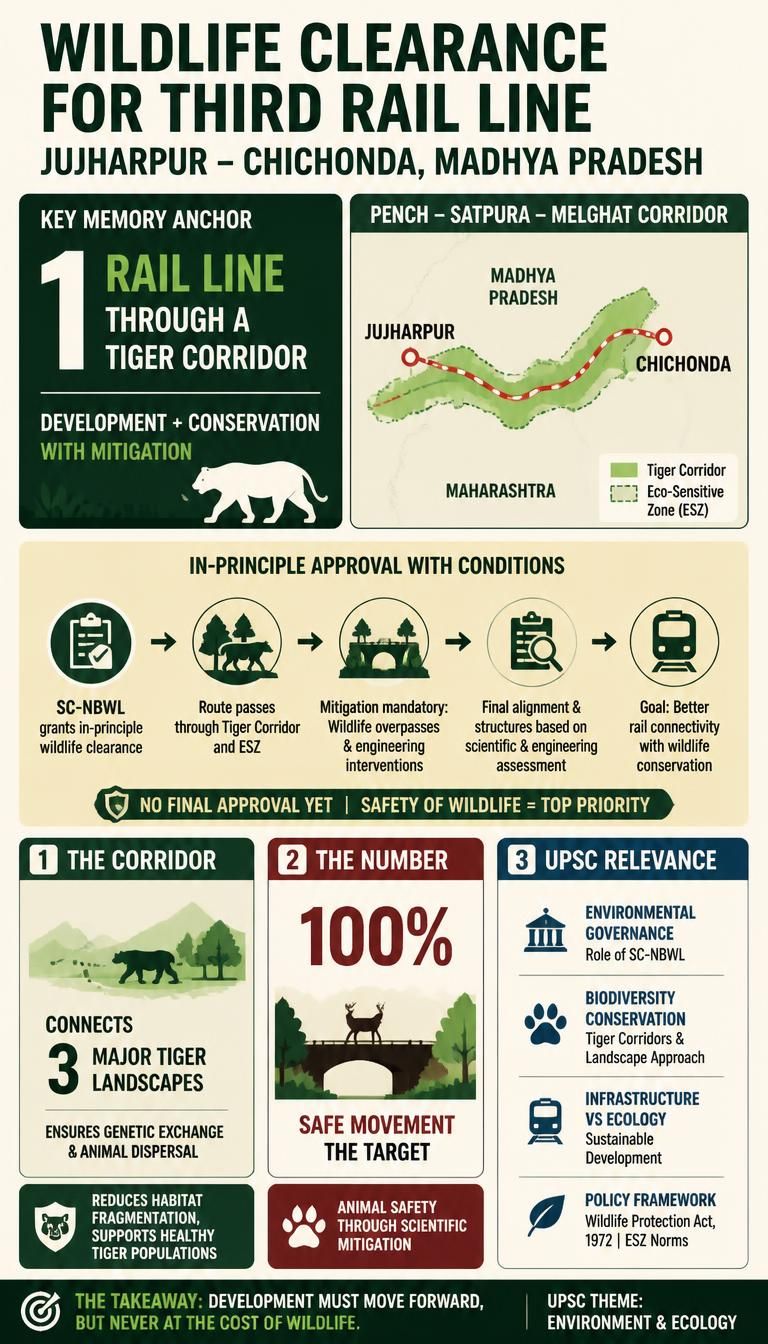
The Standing Committee of the National Board for Wildlife (SC-NBWL) has granted in-principle wildlife clearance for the third railway line between Jujharpur and Chichonda in Madhya Pradesh.
Practice MCQs
790 Students attempted
Key Highlights:
- The Standing Committee of the National Board for Wildlife (SC-NBWL) has granted in-principle wildlife clearance for the third railway line between Jujharpur and Chichonda in Madhya Pradesh.
- The proposed railway line passes through the Pench–Satpura–Melghat tiger corridor and an Eco-Sensitive Zone (ESZ), making it ecologically significant.
- The approval is conditional, requiring mitigation measures such as wildlife overpasses and other engineering interventions to ensure safe animal movement.
- The final alignment and mitigation structures will be reviewed based on scientific studies and engineering assessments before final approval.
- The project seeks to improve railway connectivity while balancing infrastructure development with wildlife conservation.
Wildlife.jpg
Detailed Insights:
- The Pench–Satpura–Melghat corridor connects major tiger habitats across Madhya Pradesh and Maharashtra, facilitating genetic exchange and animal dispersal.
- Tiger corridors are critical for the movement of tigers and other wildlife, reducing habitat fragmentation and maintaining healthy populations.
- The Standing Committee of the National Board for Wildlife (SC-NBWL) evaluates projects in protected areas and recommends safeguards to minimise ecological impacts.
- Mitigation measures such as wildlife overpasses, underpasses and fencing have been increasingly adopted to reduce wildlife mortality from roads and railways.
- The project highlights the challenge of balancing infrastructure development with biodiversity conservation in ecologically sensitive landscapes.
- Scientific planning, habitat connectivity and long-term monitoring will be essential to ensure that railway expansion does not adversely affect wildlife movement.
Key Concepts Involved:
- Tiger Corridor: A natural habitat link that enables tigers and other wildlife to move safely between protected areas.
- Eco-Sensitive Zone (ESZ): A buffer area around protected areas where developmental activities are regulated to minimise ecological impacts.
- Standing Committee of the National Board for Wildlife (SC-NBWL): A statutory body that examines projects affecting wildlife habitats and protected areas.
- Habitat Fragmentation: The breaking up of continuous natural habitats into smaller, isolated patches due to human activities.

SuperKalam is your personal mentor for UPSC preparation, guiding you at every step of the exam journey.
Download the App


STUDY RESOURCES
CONTACT US
ⓒ Snapstack Technologies Private Limited