GS 3: Science & TechnologyGS 3: Environment & EcologyGS 3: EconomyPrelimsGS 3: Infrastructure: Energy, Ports, Roads, Airports, Railways etc.
India’s first fusion power company sets road map for a nuclear reactor, Pg11
India's first private fusion company, Pranos Fusion, targets 2027 for its nuclear reactor blueprint, pioneering safe, clean energy production using advanced tokamak technology.
Practice MCQs
804 Students attempted
Key Highlights:
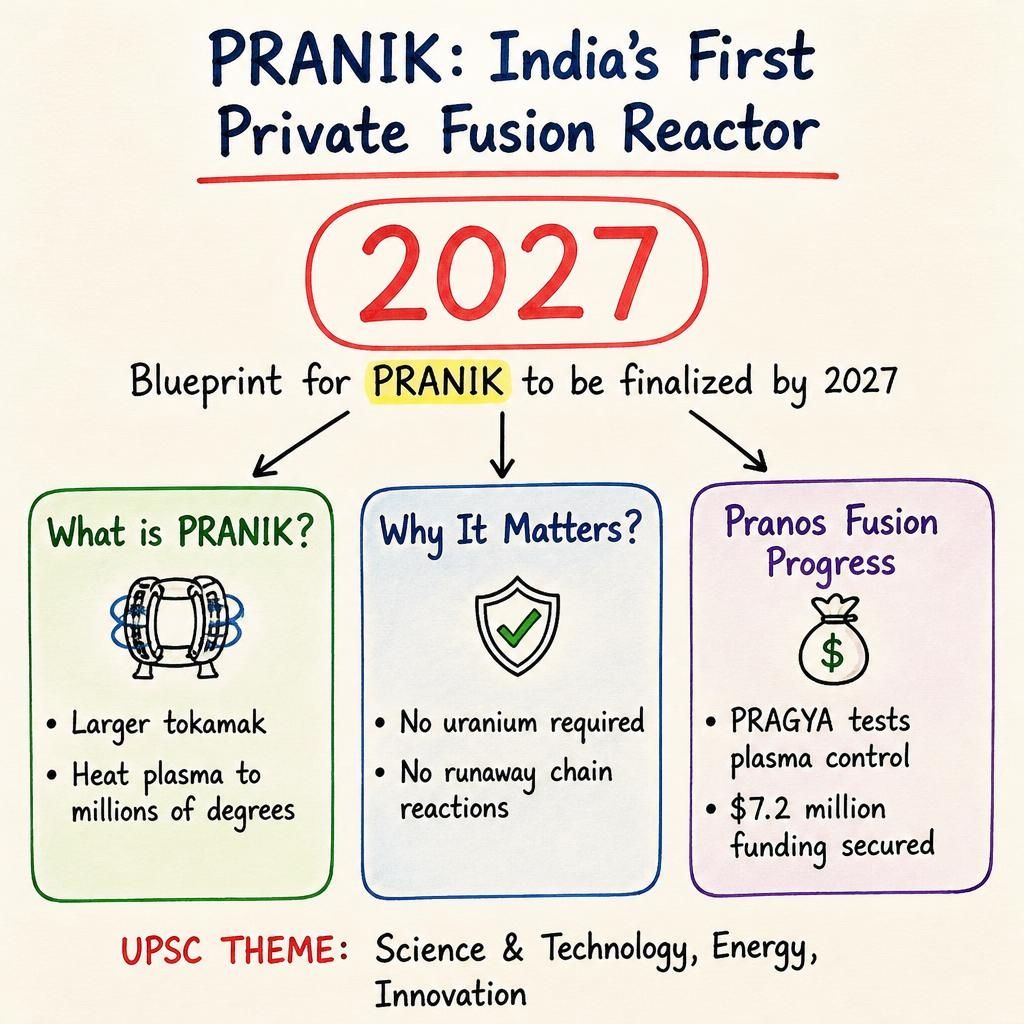
- Pranos Fusion, a Bengaluru-based startup, aims to finalize the blueprint for PRANIK, India's first privately-built nuclear fusion reactor, by 2027.
- The company has developed PRAGYA, a smaller tokamak, to test plasma control and superconducting magnets.
- PRANIK will be a larger tokamak designed to heat plasma to millions of degrees to fuse hydrogen atoms and produce energy.
- Nuclear fusion offers advantages over fission, such as not requiring radioactive materials like uranium and lacking the risk of runaway chain reactions.
- Pranos Fusion has secured $7.2 million in funding from investors including Ankur Capital and pi Ventures.
Fusion Reactor.jpg
Detailed Insights:
- Pranos Fusion is leading India's private sector efforts in developing advanced nuclear fusion technology for energy production.
- The tokamak design is crucial for fusion, using powerful magnetic fields to contain superheated plasma away from reactor walls.
- Fusion reactions typically involve combining deuterium and tritium, isotopes of hydrogen, to form helium and release energy.
- India has abundant reserves of deuterium, making it a viable fuel source for future fusion reactors.
- The use of compact machines and High-Temperature Superconducting (HTS) magnets is expected to significantly reduce the cost of fusion reactors.
- While electricity generation from fusion is still a future prospect, its potential for clean and safe energy is a major driver for research.
Scientific/Technical Concepts Involved:
- Tokamak: A toroidal device that uses strong magnetic fields to confine plasma at extremely high temperatures for nuclear fusion.
- Nuclear Fusion: The process where two light atomic nuclei combine to form a heavier nucleus, releasing a substantial amount of energy.
- Nuclear Fission: The process where the nucleus of a heavy atom splits into two or more smaller nuclei, releasing energy.
- Deuterium: A stable isotope of hydrogen containing one proton and one neutron, serving as a primary fuel for fusion reactions.

SuperKalam is your personal mentor for UPSC preparation, guiding you at every step of the exam journey.
Download the App


STUDY RESOURCES
CONTACT US
ⓒ Snapstack Technologies Private Limited