GS 3: Science & TechnologyGS 3: EconomyPrelimsGS 3: Changes in Industrial Policy and Effects on Industrial GrowthGS 3: Infrastructure: Energy, Ports, Roads, Airports, Railways etc.
Rise In EV Adoption Stresses Need For Ramping Up Charging Infra, Pg7
Surging EV sales in India highlight critical need for robust charging infrastructure, revealing significant state-wise disparities in adoption and facilities.
Practice MCQs
797 Students attempted
Key Highlights:
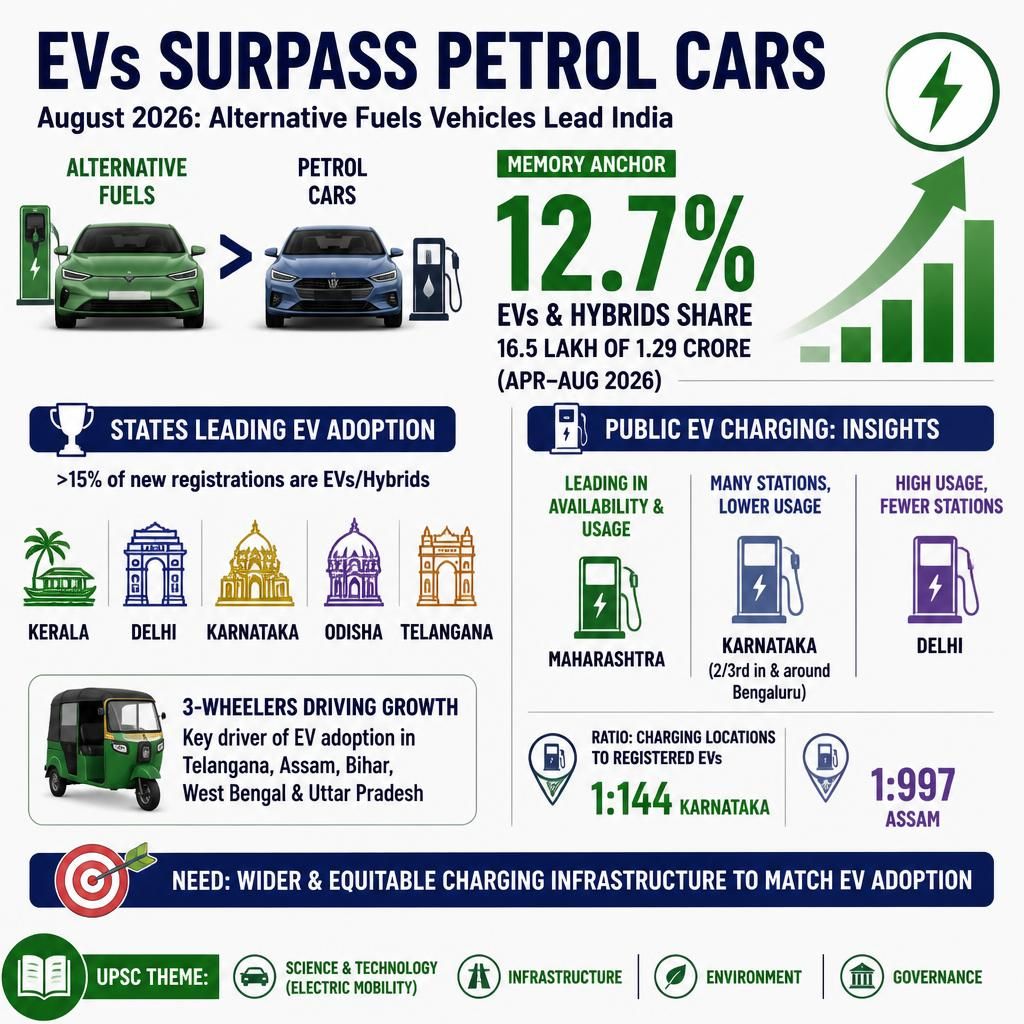
- In August 2026, vehicles under the "alternative fuels" category, including Electric Vehicles (EVs), surpassed petrol cars in sales for the first time in India.
- As of the first five months of 2026-27, EVs and hybrid EVs constituted 12.7% (16.5 lakh units) of the 1.29 crore total vehicle registrations in India.
- States like Keralam, Delhi, Karnataka, Odisha, and Telangana are leading in EV adoption, with over 15% of new registrations being EVs or hybrids.
- The growth in EV adoption in several states, including Telangana, Assam, Bihar, West Bengal, and Uttar Pradesh, is significantly driven by the three-wheeler segment.
- Maharashtra leads in both the availability and usage of public EV charging stations, while Karnataka has many stations but lower usage, and Delhi shows high usage with fewer stations.
EV Growth.jpg
Detailed Insights:
- The surge in "alternative fuels" vehicles, as reported by the Federation of Automobile Dealers Associations (FADA), indicates a significant shift in India's automotive market.
- State-wise data reveals uneven EV adoption, with notable variations even among comparable states, highlighting regional disparities in infrastructure and consumer preferences.
- Excluding three-wheelers, the share of EVs and hybrids in new registrations for 2026-27 would drop significantly below 5% in many states, underscoring the segment's impact.
- The Central Electricity Authority's report for 2025-26 shows disparities in power consumption from public charging stations, indicating varied utilization across states.
- The concentration of charging facilities in major urban centers, such as two-thirds of Karnataka's 6,000 public charging locations being in/around Bengaluru, points to a need for wider distribution.
- The ratio of charging locations to registered EVs varies widely, from 1:144 in Karnataka to 1:997 in Assam, stressing the urgency for infrastructure expansion in rapidly adopting regions.
- The Indian government has launched initiatives like the PM e-DRIVE scheme (replacing FAME II in October 2024) with a ₹10,900 crore outlay to accelerate EV adoption and expand charging infrastructure.
- The PM e-DRIVE scheme aims to install approximately 72,000 new chargers by FY 2025-26, including fast chargers for various vehicle segments, strategically placed along highways and in high-footfall areas.
- The National Electric Mobility Mission Plan (NEMMP) 2020 provides a roadmap for faster adoption and manufacturing of EVs, aiming for energy security and sustainable mobility.
Key Concepts Involved:
- Electric Vehicles (EVs): Automobiles powered by electric motors, using energy stored in rechargeable batteries.
- Hybrid Electric Vehicles (HEVs): Vehicles combining a conventional internal combustion engine system with an electric propulsion system.
- Charging Infrastructure: Network of charging stations and related facilities required to power electric vehicles.
- FAME India Scheme: Government initiative (Faster Adoption and Manufacturing of (Hybrid &) Electric Vehicles in India) to promote EV adoption through incentives and infrastructure development.

SuperKalam is your personal mentor for UPSC preparation, guiding you at every step of the exam journey.
Download the App


STUDY RESOURCES
CONTACT US
ⓒ Snapstack Technologies Private Limited