GS 1: Post-Independence IndiaGS 2: International RelationsGS 1: Modern HistoryGS 3: EconomyPrelims
In aftermath of BRICS, going back to Bandung, Pg10
India's foreign policy at a crossroads: should it reclaim the anti-imperialist spirit of Bandung and NAM, or continue aligning with US interests?
Practice MCQs
797 Students attempted
Key Highlights:
- The Bandung Conference in April 1955 brought together 29 newly independent Asian and African nations, establishing 10 principles including sovereignty and non-interference.
- This spirit led to the formal establishment of the Non-Aligned Movement (NAM) in 1961 in Belgrade, aiming to promote decolonization and advocate for a New International Economic Order.
- After the Soviet Union's collapse, NAM lost its central purpose, with many members, including India, shifting towards Western alignment.
- Formed in 2009, BRICS (Brazil, Russia, India, China, South Africa) now represents a significant portion of the world's population and economies.
- The recent BRICS summit in New Delhi issued a 140-point declaration echoing Bandung principles, calling for reforms of the UN Security Council, IMF, World Bank, and WTO, and condemning unilateral sanctions.
- BRICS aims to create a multipolar world and reform the dollar-centric global order, though it differs from NAM's anti-colonial mission.
- India, a founding member of NAM, hosted the 18th BRICS summit and advocates for greater representation of the Global South in international institutions.
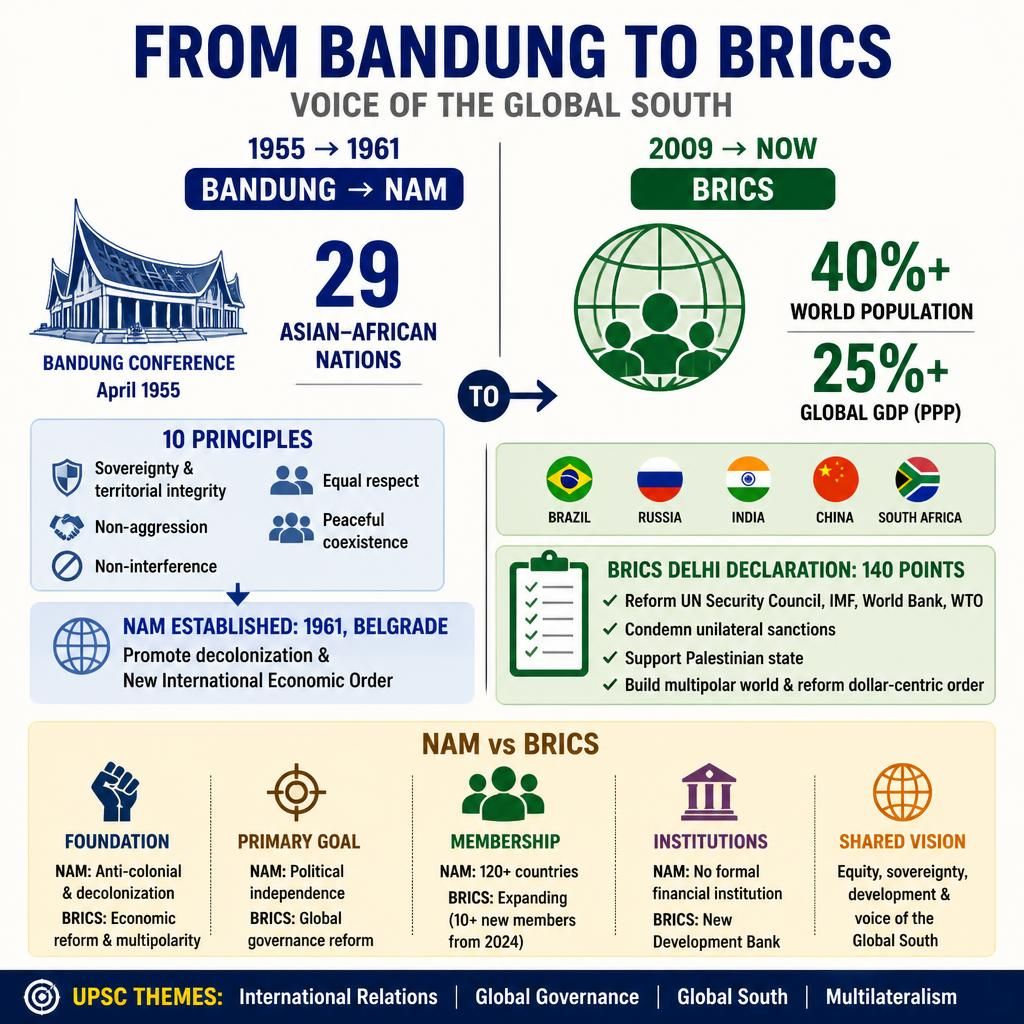
Bandung to BRICS.jpg
Detailed Insights:
- The Bandung Conference principles emphasized self-determination, mutual respect for sovereignty, non-aggression, and non-interference in internal affairs for newly independent nations.
- NAM played a crucial role during the Cold War by offering a platform for countries to avoid alignment with major power blocs, focusing on national independence and economic development.
- The demand for a New International Economic Order by NAM sought to address global economic inequalities, advocating for fair prices for developing countries' products, technology access, and a stronger voice in global economic institutions.
- BRICS seeks to provide alternatives to the existing financial system, promoting trade settled in national currencies and development finance without conditionalities.
- The expansion of BRICS and the strengthening of its institutions, such as the New Development Bank, aim to reduce the influence of any single dominant power in global affairs.
- The BRICS declaration's call for a Palestinian state and condemnation of unilateral coercive measures reflects a shared stance among many Global South nations.
- India's foreign policy faces the challenge of balancing its historical role as a leader of the Global South with its deepening strategic ties with Western powers.
- The push for reform of the UN Security Council by BRICS members, including India, aims to make global governance more democratic, representative, and reflective of contemporary geopolitical realities.
Key Concepts Involved:
- Bandung Conference: A 1955 meeting of Asian and African states promoting self-determination, sovereignty, and non-alignment.
- Non-Aligned Movement (NAM): An international organization of states not formally aligned with or against any major power bloc, founded in 1961.
- BRICS: An intergovernmental organization comprising Brazil, Russia, India, China, and South Africa, aiming to foster cooperation and development among emerging economies.
- New International Economic Order (NIEO): A set of proposals by developing countries in the 1970s to reform the global economic system for greater equity and sovereignty.
- Global South: A term referring to countries often characterized by developing economies, primarily located in Africa, Asia, and Latin America, sharing common histories of colonialism and development challenges.
- Unilateral Coercive Measures: Economic or political sanctions imposed by one country on another without international consensus or UN mandate.

SuperKalam is your personal mentor for UPSC preparation, guiding you at every step of the exam journey.
Download the App


STUDY RESOURCES
CONTACT US
ⓒ Snapstack Technologies Private Limited