GS 2: GovernanceGS 2: Social JusticeGS 3: EconomyPrelimsGS 3: Inclusive Growth
Household debt, financing today against tomorrow, Pg6
India's household debt surges to 45.5% of GDP, raising concerns about consumption-led borrowing, income inequality, and macroeconomic stability.
Practice MCQs
797 Students attempted
Key Highlights:
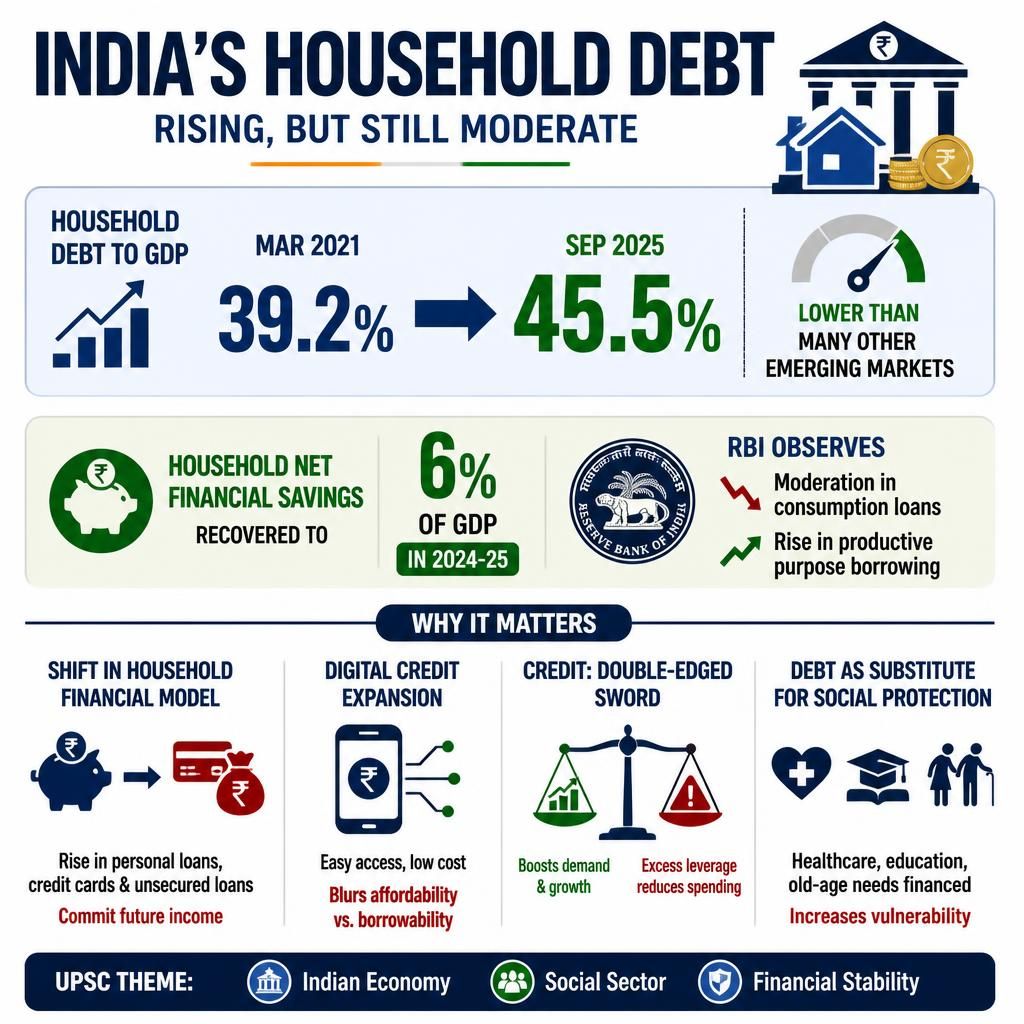
- India's household debt increased from 39.2% of Gross Domestic Product (GDP) in March 2021 to 45.5% in September 2025.
- This level of household leverage remains modest compared to several other emerging market economies.
- Household net financial savings, after declining post-pandemic, recovered to approximately 6% of GDP in 2024-25.
- The Reserve Bank of India (RBI) has observed a moderation in consumption-oriented borrowing growth, with an increase in borrowing for productive purposes.
- The article highlights the critical need to understand the underlying reasons for household borrowing, distinguishing between consumption smoothing and productive investment.
Household Debt.jpg
Detailed Insights:
- The traditional Indian household financial model, built around savings, is undergoing a significant transformation.
- The rapid expansion of personal loans, credit card borrowing, and other unsecured loans raises concerns due to their commitment of future income.
- Households with uneven income, such as self-employed or informal-sector workers, face higher risks from such borrowing.
- Digital lending platforms and app-based credit have reduced transaction costs, potentially blurring the line between what households can afford and what they can borrow.
- While credit expansion can stimulate short-term consumption and economic growth, excessive household leverage can lead to reduced discretionary spending.
- Household debt can act as a substitute for inadequate social protection in areas like healthcare, education, and old-age needs.
- Policymakers face the challenge of distinguishing between productive credit, which aids economic development, and distress credit, which sustains consumption under income pressure.
Key Concepts Involved:
- Household Debt: The total amount of money owed by all individuals and households within an economy.
- Gross Domestic Product (GDP): The total monetary value of all finished goods and services produced within a country's borders in a specific time period.
- Net Financial Savings: The difference between a household's financial assets and its financial liabilities.
- Digital Lending: The process of providing loans through online platforms and mobile applications, often with reduced transaction costs.

SuperKalam is your personal mentor for UPSC preparation, guiding you at every step of the exam journey.
Download the App


STUDY RESOURCES
CONTACT US
ⓒ Snapstack Technologies Private Limited