GS 2: GovernanceGS 3: Environment & EcologyGS 3: EconomyPrelimsGS 3: Infrastructure: Energy, Ports, Roads, Airports, Railways etc.
Eye on transmission bottlenecks, Cabinet clears green energy plan, Pg5
Union Cabinet clears Rs 1.86 lakh crore Green Energy Corridor Phase-III to evacuate 135 GW renewable energy and integrate 50 GWh battery storage by 2033.
Practice MCQs
797 Students attempted
Key Highlights:
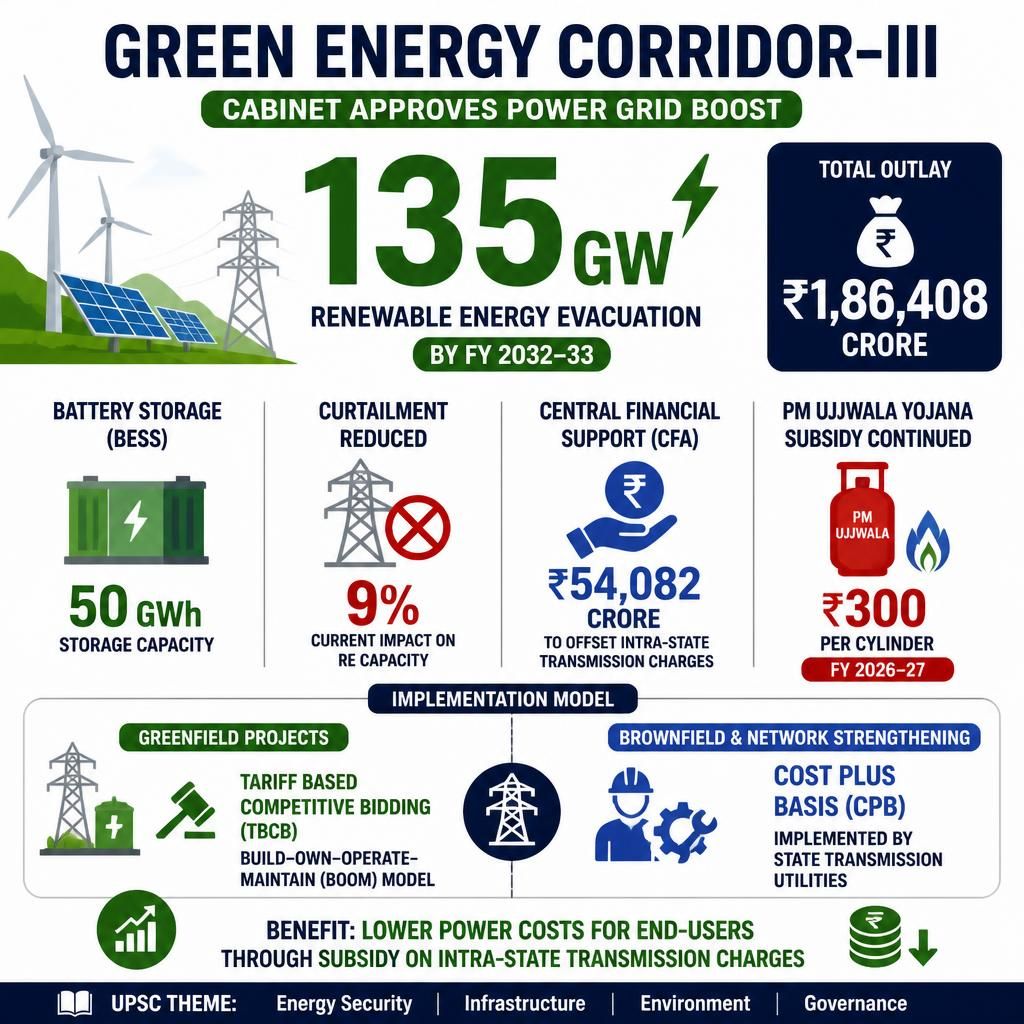
- The Union Cabinet approved the Green Energy Corridor Phase-III (GEC-III) scheme with an outlay of Rs 1,86,408 crore.
- The scheme aims to enable the evacuation of up to 135 GW of renewable energy by FY 2032-33.
- It includes a dedicated Battery Energy Storage Systems (BESS) component, providing for 50 GWh of storage capacity.
- GEC-III seeks to address transmission bottlenecks and curtailment of renewable energy, which currently affects about 9% of India's installed capacity.
- A central financial support of Rs 54,082 crore will be provided to offset intra-state transmission charges.
- The Cabinet also approved the continuation of a Rs 300 subsidy for Pradhan Mantri Ujjwala Yojana (PMUY) beneficiaries for FY 2026-27.
Green Energy Corridor.jpg
Detailed Insights:
- The GEC-III scheme focuses on developing intra-state transmission systems (InSTS) to integrate large-scale renewable energy projects.
- The BESS component is crucial for managing the intermittency of renewable energy sources and ensuring grid stability during peak demand or non-solar hours.
- Currently, around 21 GW of India's renewable energy capacity relies on temporary grid connections, leading to revenue losses for developers due to evacuation restrictions.
- The scheme's implementation for greenfield projects will be through Tariff Based Competitive Bidding (TBCB) on a Build-Own-Operate-Maintain (BOOM) model.
- Brownfield upgradation and network strengthening works will be executed under a Cost Plus Basis (CPB), with State Transmission Utilities as implementing agencies.
- The Central Financial Assistance (CFA) aims to reduce power costs for end-users by subsidizing intra-state transmission charges.
- The subsidy for PMUY beneficiaries, estimated at Rs 12,001 crore, will benefit over 10.57 crore households.
Key Concepts Involved:
- Green Energy Corridor (GEC): A network of transmission lines and substations designed to evacuate renewable energy from generation sites to consumption centers.
- Battery Energy Storage Systems (BESS): Technologies that store electrical energy for later use, crucial for grid stability and managing intermittent renewable power.
- Tariff Based Competitive Bidding (TBCB): A procurement method where bidders compete on the tariff (price) for a service or project.
- Pradhan Mantri Ujjwala Yojana (PMUY): A flagship scheme launched by the Government of India to provide clean cooking fuel (LPG) to women from Below Poverty Line (BPL) households.

SuperKalam is your personal mentor for UPSC preparation, guiding you at every step of the exam journey.
Download the App


STUDY RESOURCES
CONTACT US
ⓒ Snapstack Technologies Private Limited