GS 2: GovernanceGS 2: PolityGS 2: International RelationsPrelimsGS 2: Bilateral, Regional and Global Groupings and Agreements
India Rejects Hague Court’s Indus Waters Treaty Ruling, Says It Has No Jurisdiction, Pg11
India rejects Hague court's Indus Waters Treaty ruling, asserting no jurisdiction and calling its establishment a 'grave violation' of the treaty.
Practice MCQs
790 Students attempted
Key Highlights:
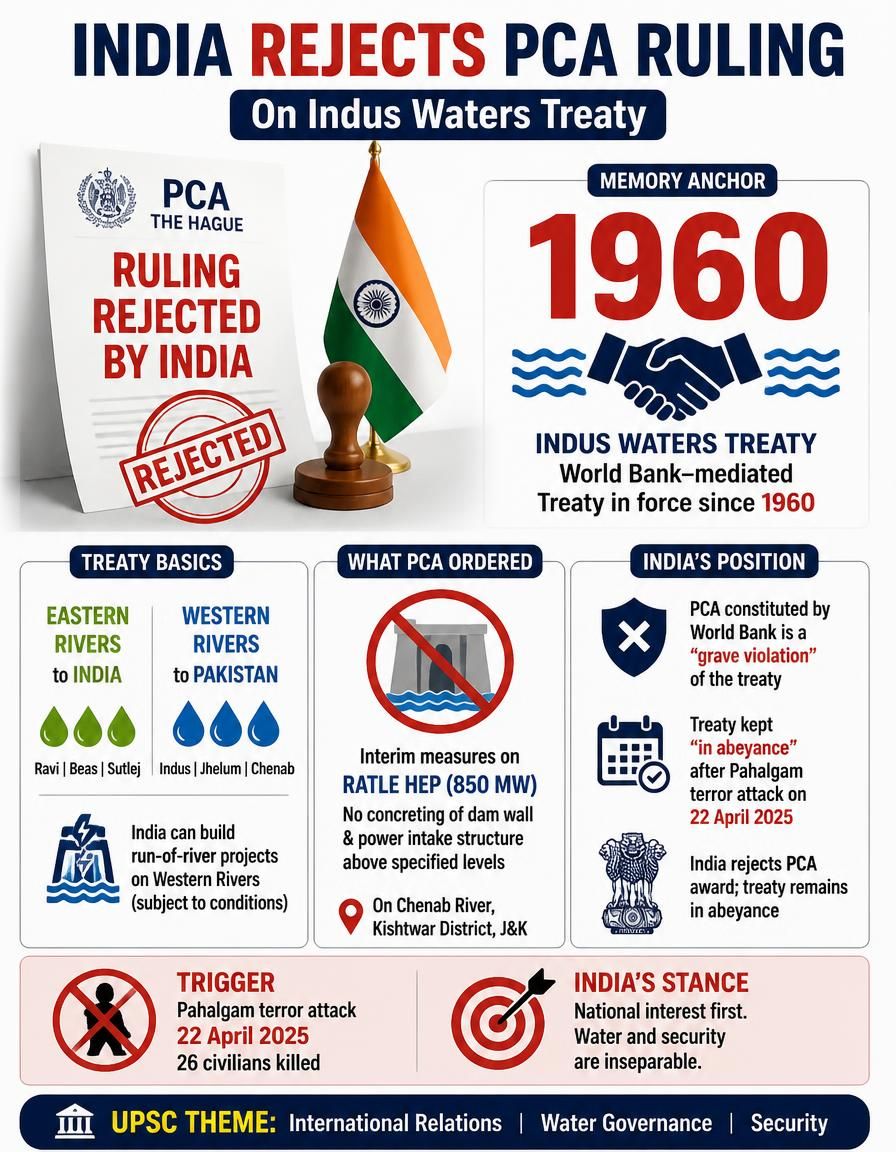
- India has rejected the ruling by the Permanent Court of Arbitration (PCA) at The Hague concerning the Indus Waters Treaty (IWT).
- The PCA stated that the Indus Waters Treaty remains "fully in force" and mandated India to observe its obligations.
- India's Ministry of External Affairs termed the establishment of this arbitral body a "grave violation" of the treaty and rejected its award.
- India reiterated its decision to keep the Indus Waters Treaty "in abeyance" following the Pahalgam terror attack on April 22, 2025.
- The PCA also imposed interim measures, prohibiting India from concreting parts of the Ratle Hydro-Electric Plant (RHEP) dam wall and power intake structure above certain levels.
IWT.jpg
Detailed Insights:
- The Indus Waters Treaty, signed in 1960 and mediated by the World Bank, allocates the Eastern Rivers (Ravi, Beas, Sutlej) to India and the Western Rivers (Indus, Jhelum, Chenab) primarily to Pakistan.
- India is permitted to construct run-of-river hydroelectric projects on the Western Rivers, subject to specific design and operational regulations.
- The Permanent Court of Arbitration, chaired by Prof. Sean D. Murphy, examined India's grounds for placing the treaty in abeyance but found them insufficient to justify suspension or termination.
- India maintains that the PCA was constituted by the World Bank in breach of the treaty's terms and therefore lacks jurisdiction over India's sovereign decisions.
- The decision to place the treaty in abeyance by India came after the Pahalgam terror attack on April 22, 2025, which resulted in 26 civilian deaths in Jammu and Kashmir.
- The Ratle Hydro-Electric Plant is an 850 MW run-of-river project located on the Chenab River in the Kishtwar district of Jammu and Kashmir.
- The Indus Waters Treaty outlines a three-tiered dispute resolution mechanism involving the Permanent Indus Commission, a Neutral Expert for technical differences, and a Court of Arbitration for broader disputes.
- India has consistently advocated for the Neutral Expert mechanism to resolve technical issues related to projects like the Ratle Hydro-Electric Plant.
- The World Bank's role under the treaty is primarily procedural, limited to designating individuals for the Neutral Expert or Court of Arbitration processes when requested by either party.
Key Concepts Involved:
- Indus Waters Treaty (IWT): A 1960 water-sharing agreement between India and Pakistan, mediated by the World Bank, governing the six rivers of the Indus system.
- Permanent Court of Arbitration (PCA): An intergovernmental organization in The Hague that provides administrative support for international arbitrations, rather than acting as a traditional court.
- Neutral Expert: A dispute resolution mechanism under the IWT for addressing technical "differences" between India and Pakistan concerning water projects.
- Western Rivers: Under the IWT, these are the Indus, Jhelum, and Chenab rivers, whose waters are primarily allocated to Pakistan, with India permitted limited non-consumptive uses.

SuperKalam is your personal mentor for UPSC preparation, guiding you at every step of the exam journey.
Download the App


STUDY RESOURCES
CONTACT US
ⓒ Snapstack Technologies Private Limited