The Increasing interest of India in Africa has its pros and cons. Critically Examine.
The Increasing interest of India in Africa has its pros and cons. Critically Examine.
India's engagement with Africa has transformed from historical anti-colonial solidarity to a comprehensive strategic partnership encompassing economic, political, and security dimensions.
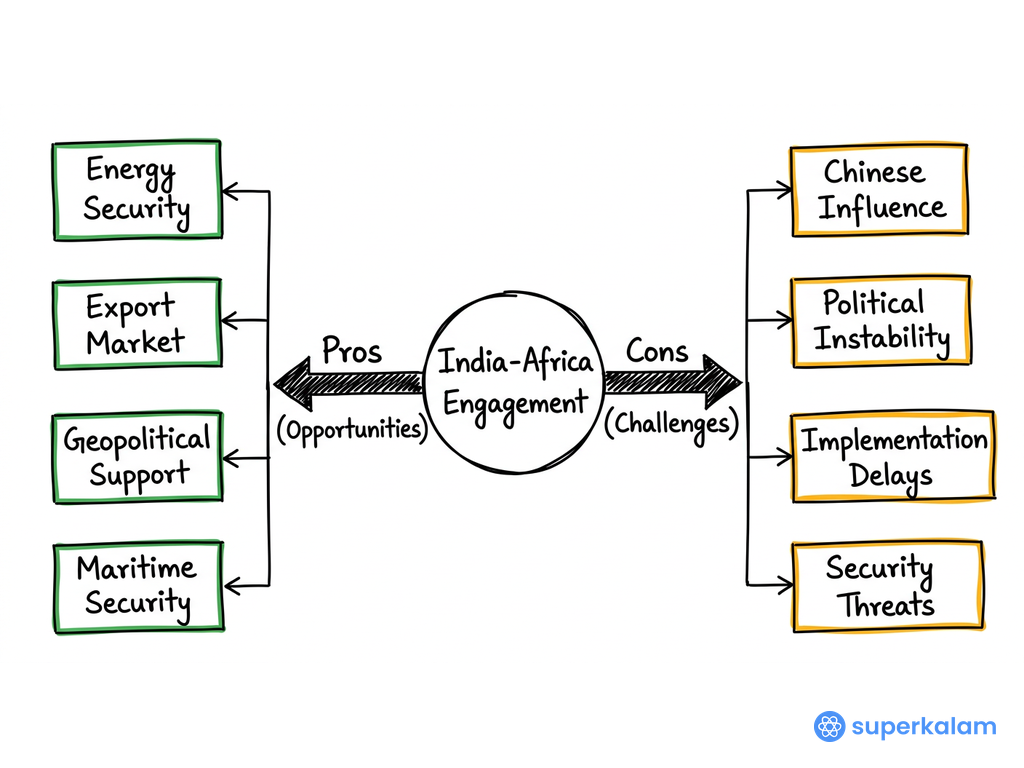
India Africa Engagement Comparative Flowchart
Advantages of India's African Engagement
Economic Opportunities
- Trade Growth: Bilateral trade reached USD 98.5 billion in 2022-23, with Africa accounting for 10% of India's global trade
- Investment Expansion: Indian companies invested over USD 70 billion across sectors like telecommunications (Bharti Airtel), pharmaceuticals (Cipla), and manufacturing
- Resource Security: Access to critical minerals like lithium, cobalt for renewable energy transition and crude oil from Nigeria, Angola
- Market Access: Africa's 1.4 billion population offers vast consumer markets for Indian goods and services
- Pharmaceutical Hub: India supplies 70% of Africa's generic medicines, strengthening health security partnerships
Strategic Benefits
- Geopolitical Influence: Counters China's Belt and Road Initiative through alternative development models focused on capacity building
- Maritime Security: Cooperation in Indian Ocean Region through initiatives like SAGAR (Security and Growth for All in the Region)
- Multilateral Support: 54 African nations provide crucial backing in UN forums and international organizations
- Technology Transfer: Digital India initiatives like Pan-African e-Network connecting 48 countries for telemedicine and education
- Soft Power: Cultural connections, yoga centers, and Team-9 cricket initiative enhance people-to-people ties
Challenges and Limitations
Economic Constraints
- Resource Competition: Intense rivalry with China, which trades USD 254 billion with Africa compared to India's smaller footprint
- Infrastructure Gaps: Limited connectivity and logistics infrastructure affecting trade efficiency
- Financial Limitations: Unable to match China's massive infrastructure financing through Belt and Road Initiative
- Trade Imbalance: Heavy dependence on commodity imports while struggling to increase manufactured exports
- Investment Risks: Political instability in countries like Mali, Sudan affecting business operations
Strategic Challenges
- Security Concerns: Terrorism, conflicts requiring costly evacuation operations (Sudan 2023, Niger 2024)
- Diplomatic Balancing: Managing relationships with competing regional powers and colonial legacies
- Capacity Constraints: Limited diplomatic presence compared to established powers
- Climate Vulnerabilities: Environmental challenges affecting long-term partnership sustainability
- Governance Issues: Corruption, weak institutions in some partner countries creating operational difficulties
(SK Map: India-Africa Trade Corridors showing major trade routes, investment destinations, and strategic partnerships across different African regions)
Critical Assessment
India's Africa policy offers significant opportunities for mutual development through South-South cooperation models. However, success requires addressing financial constraints, enhancing connectivity infrastructure, and developing innovative partnership frameworks.
The India-Africa Forum Summit mechanism and initiatives like concessional credit lines worth USD 12 billion demonstrate commitment, but sustained engagement needs long-term vision beyond immediate economic gains. Balancing commercial interests with developmental cooperation while competing with established powers remains India's primary challenge in realizing Africa's full potential.
Answer Length
Model answers may exceed the word limit for better clarity and depth. Use them as a guide, but always frame your final answer within the exam’s prescribed limit.
Evaluate this PYQ now
Write your answer & evaluate in just 60 seconds




500+ students evaluated
Model Answers from
- 2015International Relations12.5 MarksView Answer
Terrorist activities and mutual distrust have clouded India–Pakistan relations. To what extent the use of soft power like sports and cultural exchange could help generate goodwill between the two countries? Discuss with suitable examples.
- 2015International Relations12.5 MarksView Answer
Project ‘Mausam’ is considered a unique foreign policy initiative of the Indian government to improve relationships with its neighbours. Does the project have a strategic dimension? Discuss.
- 2015International Relations12.5 MarksView Answer
Discuss the impediments India is facing in its pursuit of a permanent seat in the UNSC.
Model Answers by Subject


Crack UPSC with your
Personal AI Mentor
An AI-powered ecosystem to learn, practice, and evaluate with discipline