Sufis and medieval mystic saints failed to modify either the religious ideas and practices or the outward structure of Hindu / Muslim societies to any appreciable extent. Comment.
Sufis and medieval mystic saints failed to modify either the religious ideas and practices or the outward structure of Hindu / Muslim societies to any appreciable extent. Comment.
Recent scholarship on medieval Indian mysticism reveals that while Sufis and mystic saints created significant cultural bridges, their structural impact on society remained constrained by institutional orthodoxy.
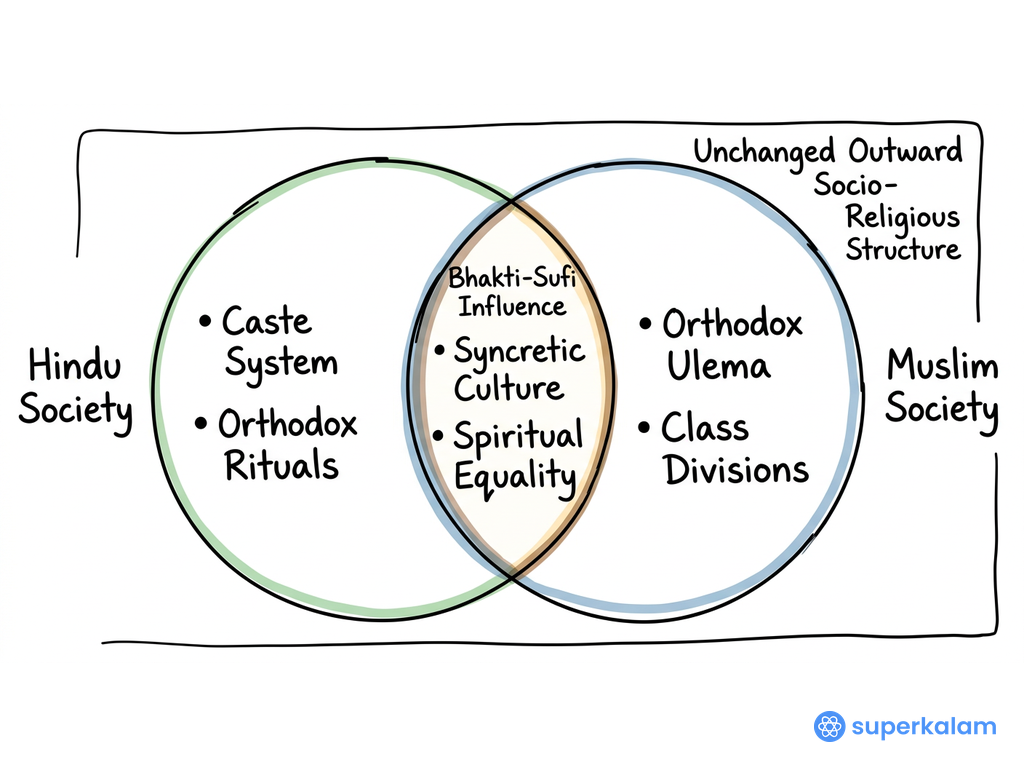
Hindu Society Venn Diagram Overlap
Limited Impact on Religious Practices
- Doctrinal Orthodoxy: Core Islamic practices like namaz, hajj, and zakat remained unchanged despite Sufi emphasis on inner spirituality
- Hindu Ritual Continuity: Traditional practices such as caste-based worship, temple rituals, and Brahmanical ceremonies persisted unaltered
- Scriptural Authority: Both Quran-Hadith in Islam and Vedas-Smritis in Hinduism maintained their orthodox interpretations
- Clerical Resistance: Ulema and orthodox Brahmins actively opposed syncretic tendencies, preserving traditional religious boundaries
- Institutional Inertia: Established madrasas and gurukulas continued teaching conventional doctrines without significant modification
Minimal Social Structural Change
- Caste System Persistence: Despite Sufi khanqahs welcoming all castes, the broader Hindu varna system remained intact across society
- Gender Hierarchies: Traditional purdah systems and patriarchal structures continued unchanged in both communities
- Economic Relations: Jajmani system and traditional occupational hierarchies persisted without Sufi-inspired modifications
- Political Structures: Medieval administrative systems remained largely uninfluenced by mystic ideologies of equality
- Marriage Customs: Endogamous practices and community-specific rituals continued despite inter-faith mystical exchanges
Achievements vs Limitations
| Sufi Achievements | Structural Limitations |
|---|---|
| Cultural synthesis through music/poetry | Orthodox religious practices unchanged |
| Inter-faith dialogue promotion | Caste system remained intact |
| Regional language development | Gender hierarchies persisted |
| Folk traditions integration | Political structures unaltered |
| Humanitarian service networks | Economic relations unchanged |
Regional Variations and Exceptions
- Deccan Success: Saints like Hazrat Gesu Daraz achieved greater local integration compared to northern regions
- Bengal Syncretism: Baul tradition demonstrated deeper structural impact on rural communities
- Punjab Synthesis: Guru Nanak's teachings created more significant social changes through Sikh community formation
- Kashmir Influence: Lal Ded and Sheikh Noor-ud-din achieved notable religious practice modifications
- Rajasthan Integration: Khwaja Moinuddin Chishti influenced local Rajput culture while structural hierarchies remained
While medieval mystics created valuable cultural synthesis and promoted interfaith understanding, their impact remained largely confined to personal spirituality rather than institutional transformation. The composite culture they fostered, however, provides contemporary India with crucial foundations for pluralistic coexistence.
Answer Length
Model answers may exceed the word limit for better clarity and depth. Use them as a guide, but always frame your final answer within the exam’s prescribed limit.
Evaluate this PYQ now
Write your answer & evaluate in just 60 seconds




500+ students evaluated
Model Answers from
- 2014Art & Culture10 MarksView Answer
Taxila University was one of the oldest universities in the world with which were associated several renowned learned personalities of different disciplines. Its strategic location caused its fame to flourish, but unlike Nalanda, it is not considered a university in the modern sense. Discuss.
- 2014Art & Culture10 MarksView Answer
Gandhara sculpture owed as much to the Romans as to the Greeks. Explain.
- 2014Art & Culture10 MarksView Answer
To what extent has the urban planning and culture of the Indus Valley Civilization provided inputs to present-day urbanisation? Discuss.
Model Answers by Subject


Crack UPSC with your
Personal AI Mentor
An AI-powered ecosystem to learn, practice, and evaluate with discipline