Most of the unusual climatic happenings are explained as an outcome of the El-Nino effect. Do you agree?
Most of the unusual climatic happenings are explained as an outcome of the El-Nino effect. Do you agree?
El Niño significantly influences global climate patterns, but attributing all unusual climatic events solely to this phenomenon oversimplifies Earth's complex climate system.
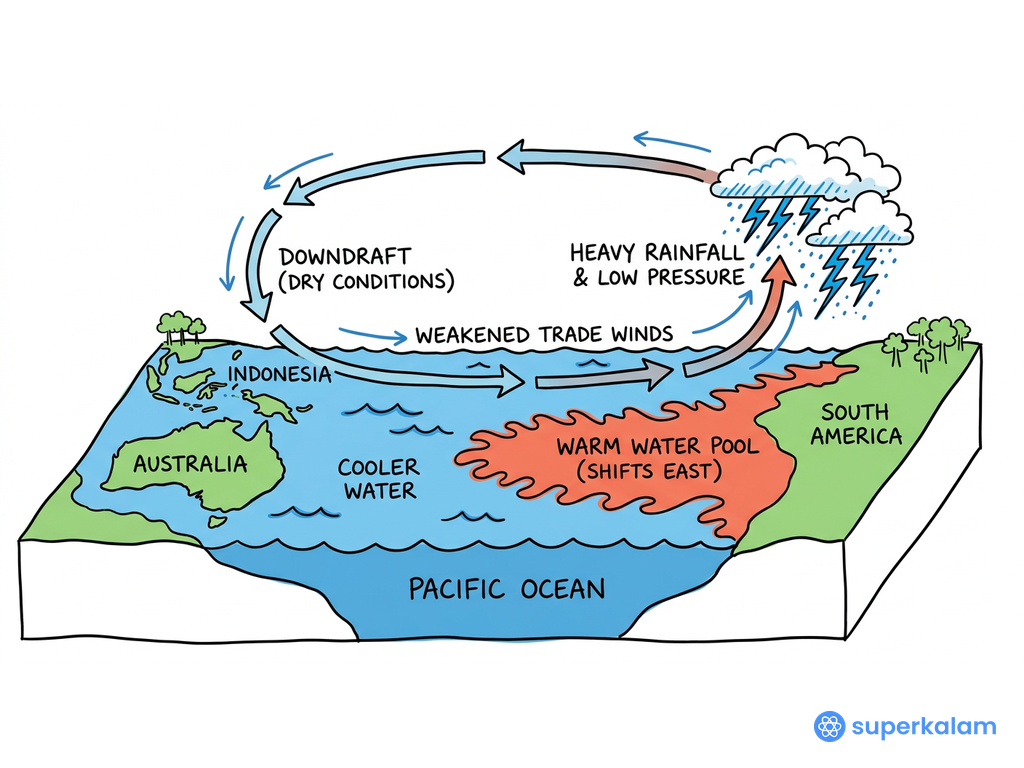
El Nino Pacific Ocean Cross Section Diagram
Role of El Niño in Climate Variability
-
Global Temperature Anomalies: El Niño warming in the eastern Pacific disrupts atmospheric circulation, causing temperature variations across continents, contributing to record-breaking heat waves like those in 2023-2024.
-
Precipitation Disruption: The 2023-24 El Niño caused severe droughts in Australia and floods in Peru, demonstrating its far-reaching impact on rainfall patterns.
-
Monsoon Suppression: India experienced delayed monsoons in 2023, with IMD linking it to moderate El Niño conditions affecting agricultural productivity.
-
Extreme Weather Events: Studies show 50% higher likelihood of extreme daily rainfall in certain regions during El Niño years, despite overall reduced precipitation.
-
Economic Impacts: The 2015-16 strong El Niño caused $45 billion in global damages through droughts, floods, and agricultural losses.
Other Significant Climate Drivers
-
Indian Ocean Dipole (IOD): The positive IOD in 2019 intensified Australian bushfires, independent of El Niño conditions, affecting over 18 million hectares.
-
Arctic Oscillation: Controls polar vortex movements, causing extreme cold snaps like the 2024 winter freeze across North America and Europe.
-
Atlantic Multidecadal Oscillation: Influences hurricane activity and European climate patterns over 20-30 year cycles.
-
Climate Change: Anthropogenic factors intensify extreme events - 2023 recorded as the hottest year globally, with greenhouse gases being the primary driver.
-
Regional Factors: Deforestation in Amazon affects local precipitation, while urbanization creates heat islands, modifying regional climate patterns.
While El Niño remains a crucial climate driver affecting billions globally, the climate system involves multiple interacting factors. The 2023 global temperature records occurred due to combined El Niño effects and long-term warming trends. Understanding this complexity is essential for accurate climate prediction and effective adaptation strategies in our changing world.
Answer Length
Model answers may exceed the word limit for better clarity and depth. Use them as a guide, but always frame your final answer within the exam’s prescribed limit.
Evaluate this PYQ now
Write your answer & evaluate in just 60 seconds




500+ students evaluated
Model Answers from
- 2014Physical Geography10 MarksView Answer
Critically evaluate the various resources of the oceans that can be harnessed to meet the resource crisis in the world.
- 2014Physical Geography10 MarksView Answer
Why are the world’s fold mountain systems located along the margins of continents? Bring out the association between the global distribution of fold mountains and the earthquakes and volcanoes.
Model Answers by Subject


Crack UPSC with your
Personal AI Mentor
An AI-powered ecosystem to learn, practice, and evaluate with discipline



